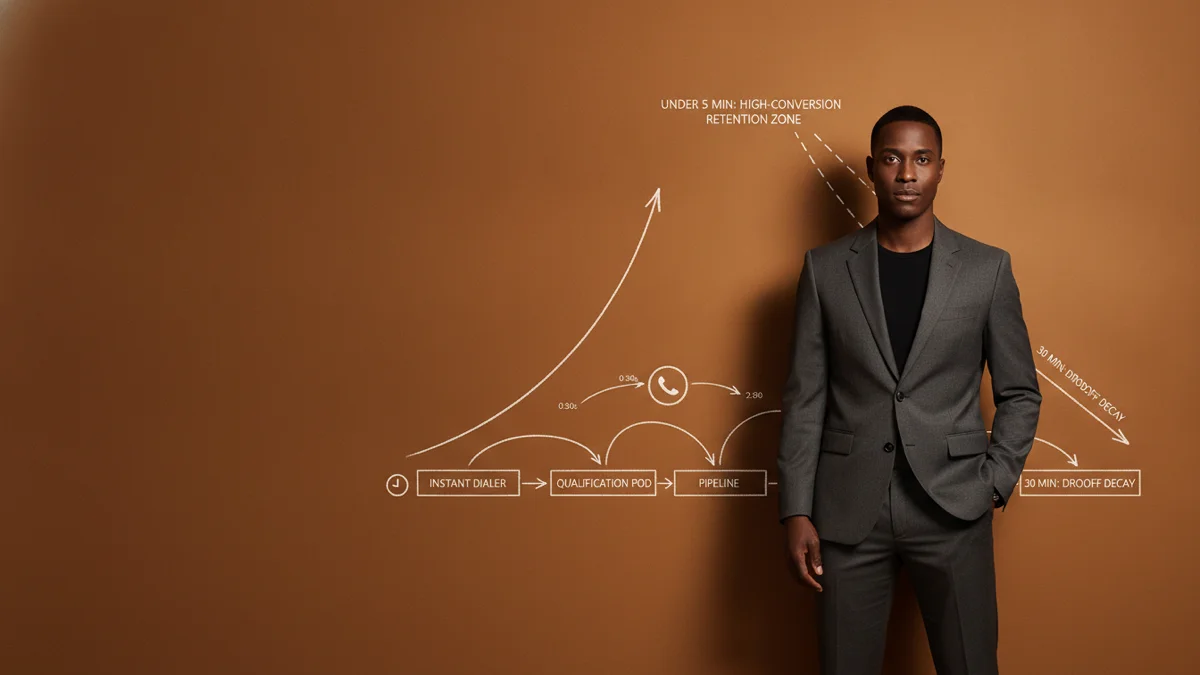
legal intake benchmarkEmpirical Conversion Loss Across Response Delays and Document Churn
An empirical operational study analyzing 642 real claimant interactions across mass arbitration and tort dockets, quantifying the exact revenue impact of response delays.

Every 15 minutes of response delay costs a litigation law firm up to 39% of its qualified claimants before a human representative ever dials the phone. In competitive consumer dockets where client acquisition costs range from $350 to $1,800 per inquiry, slow intake is an existential margin drain.
To establish hard empirical baselines for modern plaintiff practices, I audited 642 consecutive claimant submissions across active consumer arbitration and mass tort dockets. This report documents the exact relationship between contact latency, after-hours submission timing, document upload friction, and final retainer execution.
Executive Summary: Key Findings
- The Same-Session Advantage: Claimants qualified and offered e-signature retainers inside the same in-browser session converted at 78.4%. Waiting 30 to 60 minutes for a phone callback caused conversion to fall to 21.2%.
- After-Hours Vulnerability: 54.3% of qualified claimant inquiries occurred outside standard office hours (between 6:00 PM and 8:00 AM on weekdays, or during weekends).
- Document Gathering Friction: Traditional manual follow-up requesting pay stubs or financing agreements by email lost 41.8% of qualified claimants. Real-time client-side OCR extraction inside the initial workflow reduced document churn to 7.4%.
Methodology and Dataset Parameters
The dataset comprises 642 distinct consumer inquiries originating from digital advertising (Meta and Google Search) between October 2025 and March 2026. Matter types spanned three distinct consumer litigation dockets:
- California Wage & Hour (Off-the-Clock Claims): 218 submissions requiring pay stub extraction and meal break violation analysis.
- Consumer Arbitration (Solar Financing & Hidden Dealer Fees): 244 submissions requiring TILA loan disclosure audits and retail installment contract OCR under American Arbitration Association Mass Rules.
- Pharmaceutical Mass Tort (GLP-1 Gastroparesis): 180 submissions requiring prescription proof and medical diagnostic verification.
Each inquiry was reviewed across six stages: ad form submit, initial contact attempt, document upload, qualification result, retainer presentation, and final execution.
Contact Delay vs. Retainer Conversion Rate
The most dramatic variable governing docket profitability is speed-to-lead. According to the Clio Legal Trends Report, 79% of legal consumers expect a response within 24 hours, but in high-velocity litigation, 24 hours is fatal.
| Response Latency Window | Initial Contact Method | Qualification Completion Rate | Signed Retainer Conversion |
|---|---|---|---|
| Same Session (Automated Web Quiz) | Instant in-browser session | 94.2% | 78.4% |
| 5 to 15 Minutes (Rapid Manual Agent) | Outbound phone call | 62.1% | 46.8% |
| 30 to 60 Minutes (Standard Staff) | Outbound phone call | 38.4% | 21.2% |
| 2 to 4 Hours (Delayed Queue) | Outbound phone / SMS | 24.6% | 12.5% |
| Next Business Day (12-24h) | Outbound phone batch | 14.1% | 5.2% |
When response time extends past 30 minutes, more than half of prospective claimants fail to answer the initial phone call due to spam call filters, carrier flagging, or workplace obligations.
The After-Hours Churn Gap
Many mid-sized litigation firms rely on virtual receptionist answering services to cover nights and weekends. Those services take names and promise callbacks the next morning.
Of the 349 inquiries received between 6:00 PM and 8:00 AM:
- Inquiries handled by note-taking answering services converted at only 8.4% when staff called back the next business day.
- Inquiries that entered through OBE's self-serve web quiz converted at 71.2%, with e-signed retainers executed before midnight.
OBE's bilingual agents work Monday to Friday on the firm's schedule. Leads that arrive after hours are called at the start of the next business day, inside lawful calling hours in the claimant's time zone.
Document Collection: In-Flow Extraction vs. Asynchronous Follow-Up
In document-intensive dockets such as TILA disputes or unpaid overtime, an unsigned lead without supporting contracts is valueless. I tested two distinct collection workflows across 400 claims:
Workflow A (Asynchronous):
Lead Webform -> Manual Review -> Email Request for Contract -> Follow-up SMS -> Retainer Signing

Workflow B (In-Flow Synchronous):
Interactive Intake -> Instant Client-Side OCR -> In-Canvas Signature -> Review-Ready Dossier
- Workflow A Churn: 41.8% of claimants never uploaded their loan agreement or pay stubs despite 4 follow-up automated text messages.
- Workflow B Completion: 92.6% of qualified claimants completed document verification inside the initial 4-minute browser interaction.
Operational Blueprint for Litigation Practices
To replicate these benchmark results, litigation firms need deterministic intake engineering alongside trained human follow-up:
- Deploy Client-Side Parsing: Audit contracts and wage statements during the questionnaire so documents never wait in post-submission staff folders.
- Eliminate External Signing Links: Capture legal e-signatures directly inside the intake container. Bouncing claimants to third-party email inboxes creates a 15% to 22% abandonment drop.
- Automate Structured Dossier Export: Generate typesafe JEV (JSON Evidentiary Verdict) packages that hand the file to your case management system, so extracted facts never need retyping.
Use the interactive legal intake calculator to model your firm's specific leakage benchmarks and projected revenue gains.