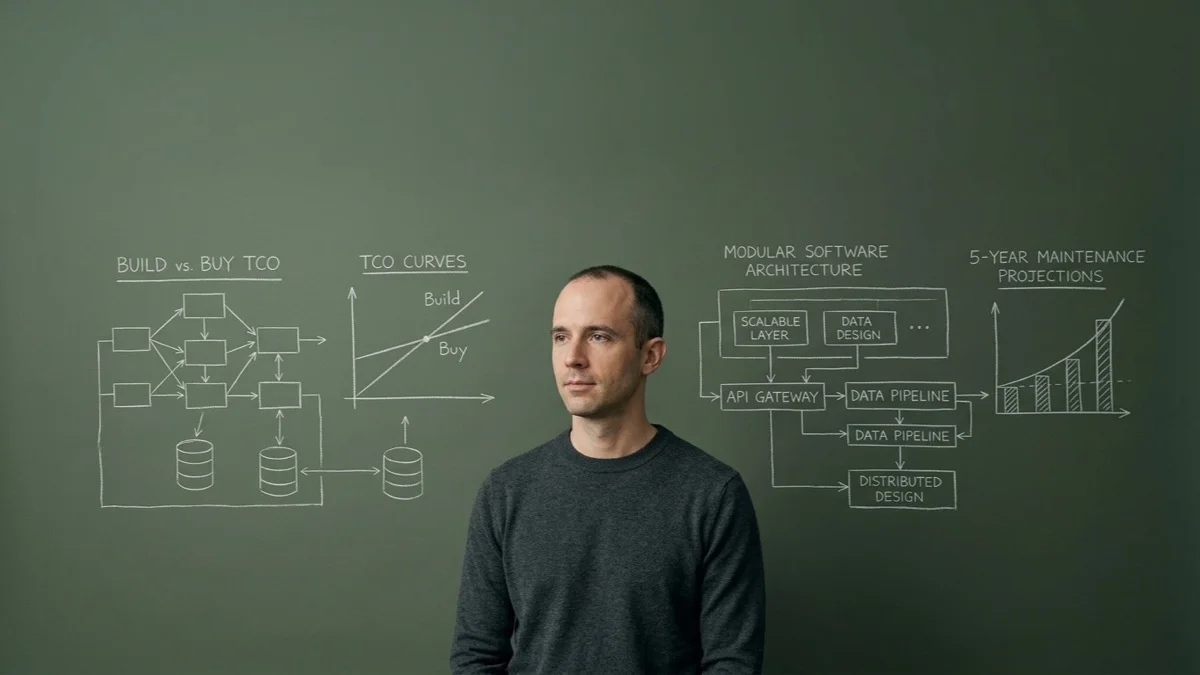
build vs buy case management softwareBuild vs. Buy Case Management Software: Why Leading Firms Choose an Owned Foundation
Why litigation firms face the build vs. buy dilemma, how perpetual SaaS seat fees drain capital, and why an owned legal codebase foundation beats both extremes.
Every growing law firm reaches an inflection point with its software infrastructure.
In the early days, commercial SaaS looks like an easy bargain. You pay eighty dollars a month per seat, flip a switch, and track case files inside a vendor's pre-configured cloud.
Five years later, the firm employs forty paralegals, fifteen associates, and a dozen intake specialists. The monthly software invoice exceeds twelve thousand dollars. More critically, you realize you are trapped in a financial black hole.
Lawyers understand property law and balance sheets intuitively. No managing partner would sign a commercial office lease where the landlord charges an extra penalty every time you hire an associate, forbids knocking down a partition to install a conference room, hikes the rent on every renewal cycle, and retains all your improvements with zero equity when you move out.
Yet in legal technology, growing firms do exactly that. They lease commercial SaaS platforms, pour hundreds of thousands of dollars into perpetual software rent, and build zero firm equity.
When leadership asks whether to keep paying escalating SaaS rent or build custom software from scratch, both paths appear treacherous.
Building from zero is like buying raw forest land, milling your own timber, and pouring concrete without blueprints. It burns $350,000 to $500,000 over eighteen months, forces your firm to become an unpaid general contractor, and often collapses under technical debt.
There is a superior third path representing the smart way for lawyers to buy the house: purchasing a pre-built, architect-engineered legal intake and case management codebase foundation. Grounded in sovereign software architecture on /stop-renting, here is how to calculate total cost of ownership across build, buy, and owned foundations.
The Practitioner Reality: Primary-Source Architecture Headaches
Law firm operations directors and technical partners discuss case management trade-offs every week. Their feedback highlights consistent friction across traditional models:
"We spent three hundred thousand dollars over eighteen months trying to build a custom intake and case tracking portal with a boutique software agency. They delivered a brittle database that broke whenever our intake team uploaded multi-page medical records. We abandoned the project and went back to spreadsheets." - Managing Partner, National Litigation Boutique
"Our annual case management software renewal jumped twenty-eight percent this year. When we asked why, the vendor pointed to new generic AI features we never asked for and do not trust. We are trapped paying sixty-five thousand dollars a year for a tool that cannot parse our specific practice area documents." - Legal Operations Director, High-Volume Plaintiff Firm
"The true cost of off-the-shelf SaaS is not the seat license. It is the human labor required to work around what the software cannot do. We have four full-time clerks whose entire job is downloading files from our intake form, typing facts into our CRM, and renaming PDFs." - Complex Litigation Chief Operating Officer
When software cannot adapt to practice-specific requirements, firms bleed margin through repetitive administrative labor.
Avoid the Endless Expenses of Building Custom Legal Software from Scratch
Building a custom case management system from scratch takes years and hundreds of thousands of dollars. OBE gives your firm an enterprise-grade codebase to own.
5-Year Total Cost of Ownership: Build vs. Buy vs. Owned Codebase
To evaluate the financial stakes, compare the five-year total cost of ownership for a sixty-person litigation practice (twenty attorneys and forty operational staff) handling complex litigation dockets:
| Financial Metric | Off-the-Shelf SaaS (e.g., Filevine / Litify Stack) | Full Custom Internal Build (From Scratch) | Pre-Built Codebase Foundation (OBE License) |
|---|---|---|---|
| Year 1 Capital Cost | $45,000 onboarding & consultant setup | $320,000 custom engineering build | $29,000 one-time license fee |
| Annual Software Licensing | $144,000/yr ($200/seat/mo across 60 seats) | $0 seat licensing | $0 seat licensing |
| Infrastructure & Hosting | Included in subscription | $18,000/yr (Private AWS or Cloudflare) | $2,400/yr (Cloudflare Edge & Supabase) |
| Integration & Custom Work | $35,000/yr third-party integrator retainers | $85,000/yr internal developer salaries | $15,000 initial case-type workflow setup |
| Five-Year Total Expenditure | $800,000+ in perpetual operating rent | $745,000+ high-risk development overhead | $61,000 complete sovereign ownership |
| Intellectual Property Ownership | Zero. Data sits in commercial multi-tenant cloud. | 100% owned firm asset. | 100% owned source code & data sovereignty. |
As shown in Bennett Legal's financial audit on /case-studies/bennett-legal, the firm spent $87,000 every single year combining Filevine, Moxo, and third-party data extraction tools before switching to a single, sovereign intake architecture.
The Comparison Matrix: Four Operational Dimensions
Evaluating case management infrastructure requires balancing speed to launch against data sovereignty and technical freedom:
| Evaluation Dimension | Off-the-Shelf SaaS | Custom Scratch Build | Hybrid Agency Build | Sovereign Codebase Foundation |
|---|---|---|---|---|
| Speed to Deployment | 2 to 6 weeks. Fast initial setup. | 12 to 18 months. Severe delay risk. | 6 to 9 months with agency coordination. | 14 days. Pre-built core with custom rules. |
| Workflow Customization | Restricted to vendor fields and logic. | Infinite flexibility, high maintenance. | Dependent on agency scope change orders. | Direct code modifications in TypeScript & SQL. |
| Data Residency & Security | Multi-tenant cloud subject to vendor terms. | Private infrastructure configured by firm. | Private cloud managed by agency contractor. | 100% private cloud matching NIST CSF 2.0. |
| API & AI Model Freedom | Closed ecosystem or rate-limited APIs. | Full API control built from scratch. | Custom endpoints dependent on vendor. | Open API, private MCP server, and native vector storage. |
| Supervisory Compliance | Generic user permissions. | Custom build must recreate ethics controls. | Variable security implementations. | Native audit trails meeting ABA Model Rule 1.1. |
Compare SaaS Rent Against Flat-Fee Permanent Ownership
Stop paying monthly per-seat fees that grow as your firm expands. A flat $29,000 single practice license gives your firm permanent codebase ownership.
The SaaS Rent Black Hole vs. Buying the House: The Real Estate Analogy for Law Firms
Lawyers understand property transactions and asset valuation better than almost any other profession. When evaluating legal software infrastructure, the exact same rules of real estate economics apply.
1. Renting Commercial SaaS: The Perpetual Sunk-Cost Black Hole
When you sign up for platforms like Clio, Filevine, or Litify, you enter a commercial lease. Every dollar paid is an unrecoverable operating expenditure poured into a black hole:
- Zero Accumulated Equity: A 60-person litigation firm spending $144,000 annually on SaaS seat licenses spends $720,000 to over $1,000,000 across five to seven years. When that contract cycle ends, the firm's accumulated enterprise balance sheet equity is exactly $0.
- The Per-Seat Tax on Firm Growth: Commercial landlords do not hike your rent every time a new associate sits at a desk. But SaaS landlords penalize your success: every new hire, temporary document reviewer, or intake specialist triggers another $150 to $250 monthly fee.
- The Remodeling Prohibition: In a rented office, you cannot knock down walls or install specialized industrial plumbing without landlord permission. In commercial SaaS, you cannot add custom mathematical formulas, geometric coordinate OCR, or bespoke arbitration workflows because your practice is trapped on the vendor's rigid, multi-tenant product roadmap.
- The Hostage Data Trap: Under ABA Model Rule 1.6, law firms have an affirmative duty to safeguard client confidential records. When you attempt to move out of a legacy CRM, vendors dump flattened CSV spreadsheets with disconnected attachments, locking your relational audit trails and operational history inside their proprietary walls.
2. Building from Scratch: The Naive Contractor Nightmare
Recognizing that SaaS rent is a financial black hole, some managing partners swing to the opposite extreme: trying to build custom software from scratch.
- Milling Your Own Lumber: Hiring a boutique software agency to build a case management platform from zero is like buying raw forest land, felling trees, milling timber, and pouring concrete foundations yourself.
- The Unpaid General Contractor Trap: Law firms are not software engineering companies. Managing agency sprints, debugging broken database schemas, and negotiating scope change orders turns managing partners into unpaid general contractors. Projects balloon from six months to eighteen months, burning $320,000 to $500,000+ before delivering a brittle prototype that crashes under real-world litigation exhibits.
3. Turnkey Codebase Ownership: The Smart Way for Lawyers to Buy
The smart way for lawyers to achieve software independence is purchasing a pre-built, architect-engineered legal codebase foundation:
- You Own the Deed and the Source Code: For a flat one-time single legal practice license fee of $29,000, your firm takes 100% ownership of the production source code.
- Turnkey 14-Day Deployment: Our engineering team deploys the complete stack directly onto your firm's private cloud (Cloudflare Edge, Supabase, or AWS) in under two weeks.
- Zero Recurring Seat Taxes: Add ten, fifty, or five hundred team members, paralegals, and co-counsel without paying an extra dime in user fees.
- Complete Remodeling Freedom: Add custom intake logic, specialized statutory penalty calculators, and private AI models directly in TypeScript and SQL. You own the house, so you remodel whenever your litigation strategy demands it.
The "Vibecoding" Trap: Why LLMs Cannot Design System Architecture
With the explosion of coding assistants and prompt-driven development, many founders and legal operations leads think: Why buy or license software at all? Why shouldn't we vibecode an entire case management and extraction system ourselves over a weekend?
That initial urge feels empowering. You describe a feature in natural language, the model generates code, and a prototype appears on your screen within minutes.
However, in professional legal infrastructure, vibecoding without architectural guardrails introduces severe technical debt. An LLM predicts tokens based on frequency across public web repositories. It optimizes for what looks complete on the surface, rather than what survives five hundred thousand real-world court exhibits. It does not know system architecture, memory locality, concurrency boundaries, or coordinate math.
The True Story: Asking an AI to Build a Parsing Engine
This exact failure scenario happened during our own early pipeline engineering. When we prompted an advanced frontier model:
Build me a high-performance document parsing and extraction engine
for our legal case management platform. It must process multi-page
PDFs, parse complex financial tables, and extract key facts for our
law firm clients.
The AI immediately replied inside the chat window with confidence:
AI Assistant:
"I recommend using Docling, IBM's open-source document parsing library! It is modern, popular, handles PDFs and complex table structures, and converts documents directly into clean Markdown or JSON for your downstream LLM pipelines. Let me generate a Python FastAPI wrapper to get you running in five minutes..."
On paper, the recommendation sounded brilliant. Docling has thousands of GitHub stars, slick documentation, and IBM branding.
Why the LLM Picks Popularity Over Legal Accuracy
Why did the model pick Docling? Because LLMs gravitate toward whatever is most discussed, recently marketed, and prevalent in public open-source chatter. The model does not understand the difference between parsing a clean academic paper and defending an arbitration claim packet in court.
When you put that AI-recommended pipeline into production on real legal records, the architecture collapses:
- Rigid Grid Assumptions Break on Real Exhibits: Open-source parsers like Docling assume clean table layouts. When confronted with real-world legal filings, merged cells, missing headers, skewed municipal stamps, and irregular row heights, the parser frequently throws fatal errors such as
COULD NOT CONVERT TO RS THIS TABLE TO COMPUTE SPANS. Densely packed numbers get merged across adjacent columns or dropped entirely. - Missing Sub-Millimeter Bounding Box Coordinates: In civil litigation, extracting a floating string of text is useless. Under legal audit rules, an attorney must click an extracted APR, overtime hour, or arbitration waiver and see the exact physical bounding box rendered on the original scanned page. Generic parsers fail to anchor every token to verified unit coordinates.
- Severe Resource Bloat: Running deep neural layout parsers on standard cloud virtual machines results in intense CPU spikes, memory exhaustion, and multi-minute latency per filing when processing hundred-page litigation packets.
1.5 Years of SOTA Research to Build OBE's Moat
It took our engineering team 1.5 years of continuous research, benchmarking, and real-world testing to discover true state-of-the-art parsing pipelines and build an extraction architecture that ranks among the top in the industry for accuracy.
We evaluated open-source parsers, cloud OCR APIs, vision-language models, and custom geometric processors across tens of thousands of complex litigation filings. We solved:
- Multi-engine routing that sends dense financial tables to specialized deterministic OCR while routing narrative contracts to multimodal vision extractors.
- Pixel-accurate coordinate anchoring with under 0.05% spatial variance across multi-column legal instruments.
- Cryptographic SHA-256 hash tracking and Bates-first document trees that stop document drift dead in its tracks.
- Real-time reactive data synchronization in TypeScript without database deadlocks.
The Double-Spend Penalty of "Building It Yourself"
The feeling of wanting to build the entire system yourself from scratch is a temporary urge. In software engineering, that urge is dangerous.
When you vibecode or hire contractors to build on AI-recommended foundations without deep domain architecture, you hit an invisible ceiling six months down the road:
- Your database locks up under concurrent paralegal reviews.
- Your vector store commingles confidential client records across tenants.
- Your extraction pipeline hallucinates dollar amounts or drops critical clauses because the underlying parser could not handle rotated PDF pages.
At that point, your firm faces a painful double spend: you throw away the money and months invested into the broken prototype, and you still have to pay to re-architect and rebuild the entire platform properly.
To save law firms and litigation boutiques that exact agony, we provide our production codebase foundation. The hard architectural choices, the benchmarked extraction pipelines, the reactive data models, and the ethics guardrails have already been engineered, tested, and proven.
The Codebase Foundation: Why Option C Wins
The debate between building from scratch and renting commercial SaaS presents a false choice.
A pre-built codebase foundation gives legal operations leaders the eighty percent of core engineering plumbing that never changes:
- Reactive Convex Backend & Schema Engine: Over two hundred relational table definitions in TypeScript, managing cases, contacts, documents, work queues, and audit trails without cold starts or fragile SQL migrations.
- Reducto Document Extraction Pipeline: Deep geometric optical character recognition that anchors extracted figures, dates, and terms directly to exact bounding boxes and page coordinates on original PDF exhibits.
- LanceDB Dense & Full-Text Hybrid Retrieval: Self-hosted vector and keyword search using zembed and zerank, providing sub-millisecond evidence discovery isolated within private per-firm storage tables.
- The Living Atlas AI Interface: A spatial UI that gives AI agents real-time semantic maps of every button, form, and page, allowing human staff and autonomous agents to manage complex litigation dockets together.
- The Capability Kernel & Flue Runtime: A sandboxed agent execution environment where tools are discovered dynamically and executed through strict safety, dry-run, and ABA ethics approval gates.
- Statement of Claim & Demand Drafting Engine: An automated legal theory detector (
packages/soc-catalog) that stacks statutory violations and generates court-ready arbitration filings automatically.
Your firm never spends engineering capital building basic authentication, file upload pipelines, or CRUD tables. Instead, your developers or our engineering team focus exclusively on the remaining twenty percent: your firm's proprietary intake qualification rules, unique settlement formulas, and private CRM integrations.
You launch in fourteen days with the operational speed of SaaS, while retaining complete ownership of the underlying intellectual property.
Do Not Get Scammed Twice: Statutory Fee-Shifting vs. Upfront Retainers
When claimants suffer corporate violations, they frequently get hit with a second financial trap: paying expensive upfront retainers or out-of-pocket legal expenses to law firms.
Under statutory fee-shifting provisions across consumer, employment, and civil rights statutes, the defending corporation must cover reasonable attorney fees and costs upon resolution. Claimants should never pay out-of-pocket retainers when their claims qualify for statutory fee recovery.
OBE equips litigation law firms with an owned intake and document extraction engine that screens fee-shifting eligibility and proves claims in minutes.
Find the Right Intake Software and Developers for Your Firm
Deciding whether to build, buy, or license legal case management software?
👉  Schedule a Consultation with Tim Ottowitz to Review Your Case Type
We will review your technical requirements, calculate 3-year total cost of ownership across build and SaaS options, and show you the power of an owned codebase.
Let us build your intake
Want us to build this exact intake pipeline for your firm?
Send us your intake questionnaire, retainer agreement, and document checklist. We will build, test, and deploy a custom, review-ready intake flow for your practice area.
Build My Intake Pipeline