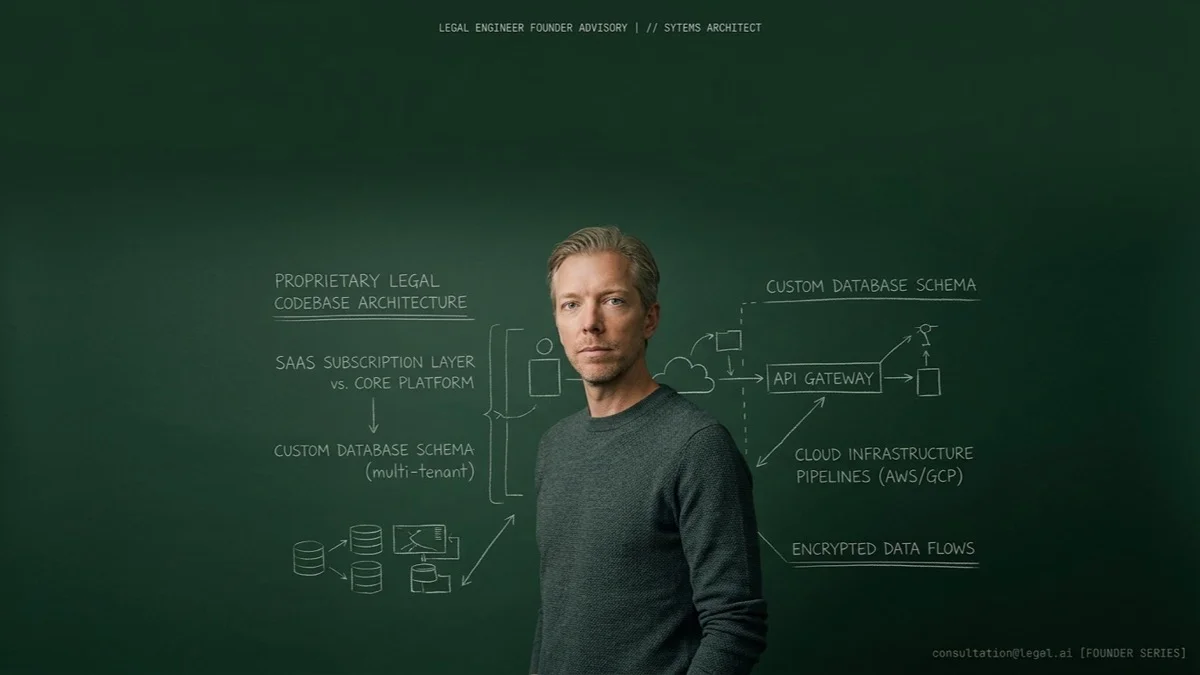
clio vs custom case managementPaying SaaS Rent Is a Black Hole of Money: Why Growing Law Firms Buy the House Instead of Renting Clio
Paying SaaS rent is a black hole of law firm capital. Why continuing to lease fragmented software stacks bleeds equity, and how smart litigation firms buy their own codebase.
Clio is the undisputed market leader for small law firms, and for good reason.
For solo practitioners, estate planning boutiques, and small family law offices, renting Clio provides an accessible starter apartment. You open an account, connect credit card processing, track billable hours, and send invoices within forty-eight hours of opening your doors. It is intuitive, reliable, and convenient.
However, paying a perpetual SaaS rent is a financial black hole.
No managing partner would sign a commercial office lease where the landlord charges an extra financial penalty every time you hire an associate, forbids knocking down a drywall partition to configure a conference room, hikes the rent on every renewal cycle, and retains all your physical improvements with zero equity when you move out.
Yet in legal technology, growing litigation firms do exactly that. They lease generic SaaS platforms like Clio, bolt on four third-party plugins, and pour tens of thousands of dollars every year into a subscription void that yields zero enterprise equity.
When your firm transitions from general practice to high-volume, evidence-heavy litigation, renting generic software begins to cripple your balance sheet and your daily casework. Grounded in systematic legal intake standards and sovereign software ownership on /stop-renting, here is why paying SaaS rent is a black hole of law firm capital, how to evaluate Clio against an owned legal stack, and how smart attorneys buy their software house instead of renting forever.
The Practitioner Reality: Trapped in the SaaS Tenant Trap
Mid-sized litigation partners and legal operations directors recount familiar breaking points when their caseload outgrows off-the-shelf software rentals:
"Clio was fine when we had four lawyers doing general civil disputes. But when we launched a specialized wage and hour practice, we needed our intake software to audit California Alternative Workweek election records and recompute daily overtime. Clio could not handle conditional mathematical formulas without expensive custom API integrations that broke every few months. We realized we were paying thousands a month to rent an apartment where we weren't even allowed to paint the walls." - Managing Partner, Employment Class Action Firm
"Our software stack looked like a frankenstein monster. We paid Clio one hundred and twenty-five dollars a seat, then paid another fifty dollars a seat for intake, twenty-five dollars for Zapier, and forty dollars for e-signatures. We were spending three thousand dollars a month for a stack where data constantly failed to sync between systems. That was thirty-six thousand dollars a year vanishing into software rent with zero equity." - Practice Director, High-Volume Personal Injury Firm
"The hardest limitation in Clio is document handling. You can upload PDFs to a matter folder, but the software cannot extract data points out of them. Our staff was still opening every police crash report or paystub and retyping the names and numbers by hand. The landlord gave us storage closets, not an assembly line." - Legal Operations Lead
When firms outgrow generic contact databases, they need deterministic data pipelines that extract evidence directly from claimant records.
Calculate the True Cost of Clio App Store Subscription Sprawl
Clio requires dozens of add-on subscriptions for intake, SMS, document extraction, and e-signatures. A sovereign intake pipeline consolidates these tools into one unified system.
The SaaS Rent Black Hole: Why Paying Software Rent Destroys Firm Equity
Lawyers understand property law and balance sheets better than almost any other profession. In real estate, the distinction between renting and owning is elementary:
- Renting Bleeds Capital: Every dollar paid to a SaaS vendor is an unrecoverable operating expenditure. If a 20-person firm pays $200 per user across Clio Manage, Clio Grow, Zapier, and document tools, it burns $4,000 per month ($48,000 per year). Over five years, that is $240,000 poured down a black hole with precisely $0 of firm equity created.
- The Per-Seat Growth Penalty: In residential real estate, having another child does not cause your landlord to increase your rent per bedroom automatically. But SaaS landlords penalize law firm success. Every time you bring on a new paralegal, intake specialist, or contract document reviewer, the vendor hikes your monthly invoice.
- The Remodeling Prohibition: In a rented property, you cannot knock down a load-bearing wall or install specialized plumbing without landlord consent. In Clio, when your litigation strategy requires extracting coordinate bounding boxes from W-2s, calculating daily overtime deltas, or embedding automated dispute notices, the vendor replies that your request is not on their quarterly product roadmap.
- The Hostage Data Problem: Try moving out of a legacy legal CRM after six years. The vendor dumps your client files into flattened CSV spreadsheets with disconnected attachments, leaving your audit trails and operational intelligence behind.
Head-to-Head Comparison: Renting Clio vs. Owning Your Legal Codebase
Evaluating whether to stay a perpetual tenant or own your software stack comes down to fundamental balance-sheet and operational vectors:
| Architectural Vector | Standard Clio Rental (Manage + Grow) | Fragmented SaaS Stack (Clio + Plugins) | Sovereign Pre-Built Legal Codebase |
|---|---|---|---|
| Ownership Model | Perpetual SaaS rental (0% equity) | Multi-vendor SaaS lease (0% equity) | 100% Owned Firm Asset (Deed to Codebase) |
| 5-Year Cost (20 Users) | $120,000+ in perpetual rent | $240,000+ in fragmented subscriptions | $29,000 one-time license ($2,400/yr private cloud) |
| Per-User Licensing Cost | $49 to $149 per seat per month | $200 to $350 per seat per month | $0 recurring user fees (Unlimited seats) |
| Remodeling & Customization | Restricted to vendor feature roadmap | Brittle webhooks and fragile Zapier syncs | Direct code-level customization in TypeScript & SQL |
| Document Data Extraction | Manual PDF upload only (no coordinate OCR) | Third-party OCR plugins with variable accuracy | Native coordinate-linked extraction directly to source PDF |
| Intake & Qualification Logic | Basic web forms with simple conditional logic | Advanced forms via Lawmatics/Jotform + Zapier | Deep deterministic intake with automated statutory audits |
| Data Sovereignty & Security | Vendor-managed multi-tenant cloud | Client records scattered across 5 to 8 vendors | 100% private cloud matching NIST CSF 2.0 |
| Ethical Supervision Guardrails | Standard user permission toggles | Disconnected audit trails across multiple tools | Immutable logging compliant with ABA Model Rule 1.1 |
See How Custom Architecture Scales with Zero Per-User Fees
As your firm grows from 5 to 50 staff, per-user SaaS subscriptions multiply your overhead. OBE offers flat single-practice licenses that never penalize firm growth.
Where Clio Honestly Excels
Clio remains an exceptional platform for standard law firm operations:
- Instant Out-of-the-Box Utility: For a firm that needs time-tracking, LEDES billing, trust accounting, and basic calendaring running this week, renting Clio is tough to beat.
- Low Initial Capital Investment: Solo practitioners can launch without upfront development costs or technical infrastructure expertise.
- Familiar Legal Workflows: Almost every paralegal and associate in the United States has used Clio, minimizing employee training for standard general practice tasks.
For a firm billing by the hour on routine matters, renting this starter apartment is completely rational.
Why High-Volume Litigation Outgrows the Rental Model
While general practice firms thrive on standard features, litigation teams hit structural walls in three key operational areas:
1. The Plugin Bloat and Integration Tax
Clio relies on its third-party app marketplace to handle specialized tasks. To achieve high-converting speed-to-lead, automated text messaging, and multi-page document parsing, firms must subscribe to four or five external software products. Every external integration introduces a potential failure point. If an API webhook fails or a field mapping changes, high-value claimants slip through the cracks unnoticed.
2. Multi-Vendor Data Distribution Risks
Under ABA Model Rule 1.6, law firms have an affirmative ethical duty to protect confidential client records. When a firm runs a fragmented software stack, client intake data, sensitive medical records, and financial disclosures travel through Zapier, third-party form builders, and external communications platforms. Each intermediary vendor expands the firm's attack surface and complicates regulatory compliance.
3. Inability to Build Enterprise Enterprise Value
High-volume law firms do not win cases on generic legal knowledge alone. They win on operational efficiency, proprietary qualification formulas, and unique evidentiary processing pipelines. When a firm builds its operational edge inside a third-party SaaS platform, it builds on rented land. It cannot package its software into a proprietary asset, cannot license its intake workflows to co-counsel, and cannot deploy custom machine learning models without vendor restrictions.
Buying the House the Smart Way: The Sovereign Codebase Foundation
When lawyers realize that renting SaaS is a capital black hole, many make the mistake of attempting the naive alternative: building custom software from scratch.
They hire a general software agency, spend $350,000 over eighteen months, and end up acting as unpaid general contractors trying to pour concrete and mill timber. Most of these custom builds collapse because law firms are not software companies.
The smart way for lawyers to buy the house is purchasing a pre-built, architect-engineered legal codebase foundation:
- A Complete Turnkey Home for Your Data: You receive the complete production source code for a flat one-time single legal practice license fee of $29,000. Our team deploys the system end-to-end onto your private cloud infrastructure within two weeks.
- All-in-One Reactive Convex Architecture: Ingest leads, run deterministic violation math, coordinate telephone interviews, and manage matter queues inside a single TypeScript codebase with zero cold starts and real-time state sync.
- Geometric Reducto Parsing: Extract timecard hours, paystub rates, and arbitration clauses with pixel-accurate bounding box coordinates directly anchored to original PDF exhibits.
- Sovereign Private Hosting: Host the application on private cloud infrastructure with isolated vector indexes, keeping client records completely isolated within your firm's security perimeter.
- Permanent Capital Savings: Eliminate monthly per-seat subscription invoices forever, reinvesting capital into client acquisition and trial preparation.
- Unlimited Expansion Without Landlord Penalties: Add ten, fifty, or five hundred intake agents, temporary document reviewers, and external co-counsel without paying an extra dollar in software licensing.
Do Not Get Scammed Twice: Statutory Fee-Shifting vs. Upfront Retainers
When consumers and employees suffer illegal conduct, paying thousands in upfront retainer fees to an attorney turns a valid grievance into a second financial hardship.
Under statutory fee-shifting laws across wage, consumer fraud, and civil rights disputes, the court or arbitration panel orders the defendant to pay reasonable attorney fees and expenses. Clients should not be asked to finance lawsuits when the law places that burden on defendants.
OBE delivers an owned case management codebase with built-in statutory assessment pipelines that qualify fee-shifting cases in seconds.
Find the Right Intake Software and Developers for Your Firm
Ready to consolidate your legal tech stack into an owned system?
👉  Schedule a Consultation with Tim Ottowitz to Review Your Case Type
We will inspect your monthly subscription stack, calculate your 3-year total cost of ownership, and demonstrate how an owned intake pipeline eliminates recurring SaaS fees.
Let us build your intake
Want us to build this exact intake pipeline for your firm?
Send us your intake questionnaire, retainer agreement, and document checklist. We will build, test, and deploy a custom, review-ready intake flow for your practice area.
Build My Intake Pipeline