
bennett legal case studyHow We Revamped Bennett Legal's 3-Question Lead Form into a Deep Data Intake
How we revamped Bennett Legal's legacy 3-question lead form into a deep data intake pipeline with a dual-mode AI voice concierge and written form, plus statutory fee-shifting qualification.
When Dallas trial attorney Charles Bennett decided to expand his practice into residential solar panel fraud and consumer arbitration, the firm ran straight into an operational brick wall.
The firm had high-ranking educational blog posts and organic guides detailing Texas deceptive trade practices, door-to-door sales scams, and predatory utility rate promises. Traffic was surging. Defrauded homeowners across the state were visiting the site every day.
Yet their intake mechanism was identical to what 95% of plaintiff litigation firms use:
A generic three-question lead form with a Case Type dropdown (Personal Injury, Car Wreck, Solar Panel, Green Energy), basic contact fields, an open-ended free-text box asking "Tell us what happened," and an office phone number printed across the header of every page.
The result was pure operational paralysis.
Callers spent 30 to 45 minutes on the phone with front-desk staff explaining heartbreaking, emotional stories, only for attorneys to discover at the end of the week that the contractor was already bankrupt, the loan was outside the statute of limitations, or the claimant had no documentation to substantiate Truth in Lending Act (TILA) violations.
We completely dismantled that broken model.
Below is the exact before-and-after evolution: how we took Bennett Legal's legacy 3-question form, engineered a deterministic statutory qualification pipeline, and deployed the live dual-mode embed featuring Sarah, their AI Voice Concierge, alongside a progressive written dossier form.
OLD Version
The generic three-question dropdown form Bennett Legal originally used, leading to 30-minute screening calls, missing statutory fee-shifting data, and days of clerical follow-up.
Get a Free Consultation
Tell our Dallas legal team about your situation. We will call you back within 48 business hours.
Scroll down to see the revamped, production-grade embed deployed across Bennett Legal's solar articles and service pages
The new way of intake
Dynamic text and voice intake custom tailored to your case types, embedded on your website, organic content & sales funnels with structured data right into the OBE CRM.
Connecting to AI Voice Concierge (Sarah)...
Live microphone access will be requested so you can speak naturally
The Origin: A 1-Hour Consultation Call with Charles Bennett
The transformation began with a single one-hour consultation call between managing attorney Charles Bennett and Tim Ottowitz, founder of OBE.
Charles pulled up Bennett Legal's Google Analytics and call logs. The numbers showed a painful mismatch:
- Thousands of homeowners were reading Bennett Legal's articles on Texas solar panel misrepresentations, loan origination deception, and inverter failure.
- But 88% of visitors bounced without taking action.
- The 12% who did reach out either entered sprawling, unpunctuated paragraphs into the website's free-text box or dialed the firm's direct phone number at 9:00 PM.
"Our front desk and paralegals are spending half their working hours acting like amateur therapists," Charles explained on that call. "People call us crying because their electric bill doubled, their roof has water damage, and some non-bank lender named GoodLeap or Sunlight is taking $300 a month straight out of their checking account.
Our team takes handwritten notes, types them into a shared Google Sheet, and calls the homeowner back two days later asking for their loan disclosure sheets. By the time we review the paperwork, half of them don't qualify, and the other half have stopped answering our calls.
We need a dedicated intake specifically tailored for all our solar blog posts and our solar service page, a direct mechanism for solar claimants to enter all their case facts upfront. We only want our lawyers reviewing viable, high-value files."
On that 1-hour call, we agreed on the core objective: Construct a review-ready arbitration dossier from every inquiry.
Ready to Map Your Firm's Intake Pipeline?
Capture high-value claimants with an intake pipeline built for your case type. We will walk through your target claims, reverse-engineer your qualification questions, and build a deterministic intake pipeline tailored to your firm.
👉Book a 30 minute free consultation call to map your cases with Tim
Why Consumer Arbitration Demands Statutory Fee-Shifting Qualification
To understand why a generic 3-question lead form fails in high-volume consumer litigation, you have to understand the underlying legal economics of plaintiff-side consumer arbitration.
In personal injury or motor vehicle wreck cases, liability and damages are largely established through police accident reports and emergency room records. In statutory consumer arbitration, cases live or die on statutory fee-shifting triggers and forum fee allocation rules.
Defrauded homeowners who have been coerced into $60,000 rooftop solar loans cannot afford to pay an attorney $500 an hour. A viable plaintiff practice must rely on statutory fee-shifting provisions where the defendant lender is legally compelled to pay the claimant's reasonable attorney fees upon resolution.
If an intake workflow fails to capture specific statutory facts upfront, an attorney cannot determine whether a case is economically viable or a financial black hole.
┌────────────────────────────────────────────────────────────────────────┐
│            STATUTORY FEE-SHIFTING TRIGGERS IN SOLAR INTAKE             │
│            (Why Generic Forms Fail and Deep Intakes Win)               │
└────────────────────────────────────────────────────────────────────────┘
 [ Homeowner Lead ] ──> Generic 3-Question Form ──> "My panels don't work!"
                              │
                              ▼ (No Statutory Facts Captured)
 [ Paralegal Clutter ] ──> Chasing Contracts & Retyping Unstructured Notes
                              │
                              ▼ (Financial Risk)
 [ Unviable Case File ] ──> Bankrupt Installer, No Solvent Defendant, $0 Fees

 ══════════════════════════════════════════════════════════════════════════

 [ Homeowner Lead ] ──> OBE Deep Data Intake Pipeline
                              │
                              ▼ (Structured Fact Extraction)
 ├─ 1. FTC Holder Rule (16 CFR § 433.2) ────> Attaches liability to solvent lender
 ├─ 2. TILA Hidden Dealer Fees (15 U.S.C.) ─> Exposes disguised 30% origination fee
 ├─ 3. Texas DTPA § 17.50(b) (Age 65+) ─────> Unlocks mandatory treble damages
 └─ 4. 300% FPL Poverty Guideline ──────────> $0 AAA consumer fee, lender pays $7.5k
                              │
                              ▼ (Evidentiary Certainty)
 [ Review-Ready Dossier ] ──> One-Click Attorney Approval & Immediate Retainer E-Sign
During our engineering sprint with Bennett Legal, we mapped out four non-negotiable statutory pillars:
1. The FTC Holder Rule (16 CFR § 433.2) and Solvent Defendants
Door-to-door solar contractors (Titan Solar, Pink Energy, Vision Solar) go bankrupt with alarming regularity. Filing an arbitration demand or civil lawsuit against an installer that dissolved six months ago yields an uncollectible paper judgment.
Under the Federal Trade Commission's Holder Rule (16 CFR § 433.2), consumer credit contracts must contain a mandatory notice stating that any holder of the credit contract is subject to all claims and defenses which the debtor could assert against the seller.
By capturing the exact non-bank financing institution upfront (GoodLeap, Sunlight Financial, Mosaic, Dividend, Concert Finance, or EnFin), the intake pipeline immediately establishes a solvent, insured institutional defendant.
2. Undisclosed Dealer Fees and Truth in Lending Act (TILA) Violations
Predatory solar sales operations routinely quote a cash price of $40,000, but when the consumer signs the financing agreement on a sales rep's iPad, the principal balance is inflated to $55,000 or $65,000.
The extra $15,000 to $25,000 represents a hidden "dealer fee" or origination markup disguised inside the loan balance to support an artificially low interest rate (e.g., 2.99% or 3.99% APR).
Comparing the cash installation price to the total financed loan amount uncovers hidden finance charges that violate the Truth in Lending Act (TILA, 15 U.S.C. § 1640), exposing the lender to statutory damages, loan rescission, and mandatory fee-shifting.
3. Client Signing Age: The Elder Fraud Treble Damages Multiplier
Predatory sales representatives aggressively target senior citizens on fixed Social Security incomes, falsely claiming that solar panels are subsidized under federal government grants.
Capturing the claimant's exact age at the date of contract execution unlocks critical statutory firepower: Under the Texas Deceptive Trade Practices-Consumer Protection Act (DTPA § 17.50(b)), when an unlawful deceptive act is committed against an elder consumer (age 65 or older), the court or arbitrator is authorized to award treble damages (up to three times actual economic damages) plus court-ordered attorney fees.
A $50,000 loan balance dispute immediately transforms into a $150,000 statutory claim.
4. The 300% Federal Poverty Level (FPL) AAA Fee Waiver
Arbitration forums like the American Arbitration Association (AAA) and JAMS require substantial filing and administration fees. While standard consumer arbitration rules cap the consumer's filing fee at $200 (AAA) or $250 (JAMS), even $200 can be an insurmountable hurdle for a defrauded retiree living paycheck to paycheck.
The intake pipeline asks for household size and income at the time of execution. The system dynamically benchmarks these figures against the Federal Poverty Guidelines.
Claimants whose income falls below 300% of the Federal Poverty Level qualify for a 100% filing fee waiver. The homeowner pays $0. The respondent lender is ordered to pay the full administration and arbitrator fees (ranging from $5,000 to $15,000 per case), creating immediate, immense settlement pressure on the financing institution before the first preliminary hearing is held.
Identify Fee-Shifting Triggers in Your Practice
Whether you handle consumer fraud, TCPA violations, wage-and-hour claims, or deceptive trade practices, your intake must capture statutory fee-shifting facts upfront.
👉
Reverse-Engineering the Intake Questions from the Desired Legal Case
We start from the finished file and ask:
"What does a winning, review-ready case file look like when it lands on the managing attorney's desk?"
We started by examining Charles Bennett's formal AAA Statement of Claim, his arbitration demand exhibits, and his firm's retainer agreement. We worked backward from the end state:
-
What specific exhibits must be attached to the arbitration demand?
- The original solar installation agreement.
- The financing disclosure note and Truth in Lending disclosure statement.
- Twelve consecutive months of electric utility bills showing continued grid charges.
- The electronic signature audit trail (DocuSign or PandaDoc certificate) to substantiate signature forgery claims.
- The county deed record to inspect any UCC-1 fixture filings or mechanics liens encumbering the title.
-
What facts trigger automatic disqualification?
- Commercial installations (consumer arbitration rules do not apply).
- Cash deals where the installer is already dissolved and no financing entity exists.
- Claims exceeding the 4-year Texas breach of contract or fraud statute of limitations with no tolling basis.
-
What data points belong in the structured Factframe?
- We defined 40 distinct case variables, from the solar inverter model and manufacturer warranty status to the exact interest rate markup and household poverty percentage.
By reverse-engineering from the desired arbitration demand, every question in the intake serves an evidentiary purpose, eliminating extraneous fields while capturing all required legal predicates.
Phase 1: Mapping the Decision Tree into a Structured Written Form Flow
Once the statutory requirements and qualification criteria were locked in, we designed the progressive written questionnaire.
We split the 25 questions across bite-sized, logical milestones:
┌────────────────────────────────────────────────────────────────────────┐
│                   THE MILESTONE INTAKE ARCHITECTURE                    │
└────────────────────────────────────────────────────────────────────────┘

 [ Milestone 1: Zero-Friction Identity Capture ]
   • First & Last Name
   • Verified Mobile Phone Number
   • Email Address
   • Preferred Communication Channel (SMS, iMessage, WhatsApp, Email)
   ──> INSTANT STATE SAVE IN OBE CRM (Automatic 3-Stage SMS Recovery on Drop-off)

 [ Milestone 2: Venue & Gatekeeper Classification ]
   • Property Street Address (Auto-resolves City, State, County, ZIP)
   • Locks in correct AAA Regional Center (Dallas / Fort Worth)
   • Confirms residential single-family homeowner status

 [ Milestone 3: Lender & Financing Identification ]
   • Non-bank lender selection (GoodLeap, Sunlight, Mosaic, Dividend, etc.)
   • Cash price vs. total financed balance (discloses hidden dealer fees)
   • Monthly solar payment amount vs. current utility bill amount

 [ Milestone 4: Statutory Multipliers & Evidence Uplink ]
   • Homeowner age at contract execution (Flags DTPA Elder Treble Damages)
   • Household size & income (Dynamic 300% Federal Poverty Level waiver)
   • Mobile document upload: Disclosure note, utility bills, DocuSign audit trail
Milestone 1 Save-State & Automated Session Recovery
Multi-step web forms lose claimants to abandonment. If a claimant reaches step 3 and gets interrupted by a phone call, a typical form discards the submission.
In the OBE pipeline, completing Milestone 1 immediately persists the record into the firm's CRM database as Stage 1: New.
If the claimant drops off before uploading documents, the CRM triggers an automated recovery sequence. Over the next two weeks, the system sends three personalized reminders via their selected communication channel (SMS or email). Each message contains an authenticated, state-preserving link that reopens the exact question where they left off without forcing them to re-enter their name or contact info.
Recover Abandoned Claimants Automatically
Traditional web forms discard unfinished submissions when users get interrupted. In the OBE pipeline, completed milestones persist immediately with automated SMS and email recovery.
👉
Phase 2: Translating the Case Map into Sarah, the AI Voice Concierge
A structured written form solves the data problem for desktop users and disciplined typists. But when a defrauded homeowner is sitting at their kitchen table on an iPhone, holding an electric bill they cannot afford, typing out loan account numbers and legal explanations is overwhelming.
Traditional answering services fail here. Answering service operators are minimum-wage call center workers with zero legal training. They cannot probe for FTC Holder Rule applicability, they don't know what a UCC-1 lien is, and their handwritten call notes create an administrative swamp for paralegals.
To bridge this gap, we translated Bennett Legal's case-mapping logic into Sarah, their AI Voice Intake Concierge (as shown in the live embed above).
How Sarah Conducts a 5-Minute Evidentiary Interview
Sarah is an empathetic, voice-synthesized legal intake advocate trained on the firm's exact qualification decision tree:
-
Active Listening and Empathy:
When a caller says, "A salesman came to my house, told me the panels were free under Biden's clean energy program, and now I'm stuck paying $299 a month to GoodLeap," Sarah lets the caller finish, then validates the caller's frustration with professional empathy: "I'm so sorry you're dealing with that. We hear this exact story from homeowners across Texas every day, and our legal team is actively taking on GoodLeap for these exact deceptive sales practices." -
Live Entity Extraction:
While speaking, Sarah parses the audio stream and extracts structured key-value entities in real time:Solar Company: Freedom SolarLender: GoodLeapSolar Monthly Payment: $299Claim Type: Residential Solar Deceptive Trade Practices
-
Dynamic Question Branching:
Because Sarah detected GoodLeap as the financing entity, she immediately knows which statutory claims apply. She branches to the next evidentiary requirement: "Did the sales rep show you the GoodLeap loan agreement on paper before you agreed, or did they have you sign quickly on an iPad where you never saw the final loan balance?" -
Statutory Qualification Probing:
Sarah gently inquires about claimant age and household income, immediately flagging whether the client qualifies for Texas DTPA elder fraud treble damages and a 300% FPL AAA filing fee waiver. -
Direct Factframe CRM Ingestion:
At the conclusion of the 5-minute call, Sarah saves a verified 40-point Factframe directly into Bennett Legal's custom CRM dashboard, so no paralegal retypes the answers.
Deploy an AI Voice Concierge Custom-Trained for Your Firm
Test our live voice concierge technology on your own caseload. In a 30-minute working call, we'll map your firm's qualification criteria into Sarah's conversational engine.
👉
Channeling Data into the CRM and the Production Intake Workstation
Clean answers pay off when that structured data lands in a purpose-built legal CRM. Bennett Legal routes every submission directly into the OBE Legal Intake CRM, engineered specifically for high-volume arbitration and litigation.
Operations managers and attorneys oversee the firm's intake pipeline through a unified, real-time command center:
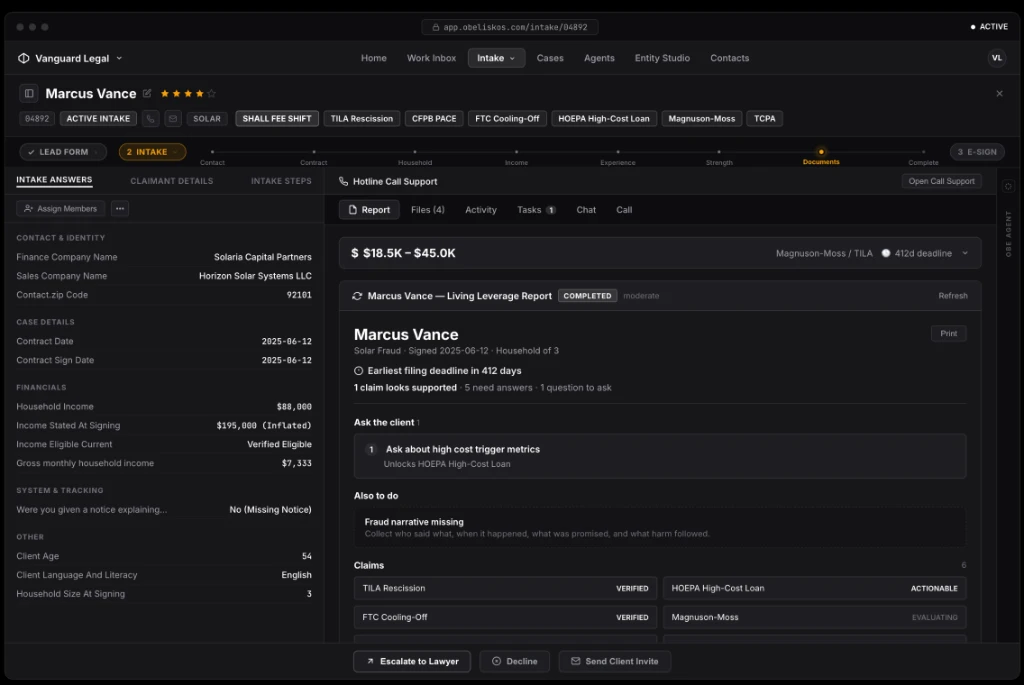
The Production Intake Command Center: Real-Time Living Valuation
-
Automated Statutory Claim Classification (Header & Badges):
The platform's legal issue engine evaluates extracted intake variables against statutory rules in real time. As shown in the active file above, the system immediately tags:- Fee-Shifting Mandate: Flags
SHALL FEE SHIFTalongside specific federal causes of action. - Statutory Claims Identified: Verifies
TILA Rescission,FTC Cooling-Off, andHOEPA High-Cost Loan, while actively evaluatingMagnuson-Mosswarranty breaches. - PACE / Consumer Credit Detection: Confirms non-bank finance company terms and highlights discrepancies like inflated income stated at signing ($195,000 stated vs. $88,000 actual).
- Fee-Shifting Mandate: Flags
-
Living Valuation Report & Damages Valuation:
The platform automatically calculates the claimant's dispute valuation range ($18,500 to $45,000) based on statutory damages, finance charge restitution, and fee-shifting exposure. It tracks the earliest filing deadlines (e.g., 412 days remaining) and generates a concrete action list of missing evidence needed before filing. -
Multi-Stage Document & Verification Pipeline:
The top progression bar tracks each file fromLead FormthroughIntake(Contact, Contract, Household, Income, Documents) toE-Sign. Staff click any uploaded exhibit to inspect spatial bounding boxes tied permanently to the source pages. -
One-Click Attorney Escalation & Retainer Delivery:
Once claims and exhibits are verified, a single click (Escalate to Lawyer) routes the file to managing counsel, who approves the matter and dispatches a pre-populated engagement retainer for instant mobile E-SIGN.
The entire process, from initial website visit to a fully signed engagement retainer, takes minutes.
Tour the Production Legal Intake Workstation
See how managing attorneys use real-time Living Valuation reports, statutory verification badges, and one-click retainer e-signatures to process hundreds of files a month without administrative bloat.
👉
How OBE Onboards Your Firm: The 14-Day Case Mapping Framework
If your law firm is struggling with unqualified leads, bloated intake call center costs, or manual document chasing, you can deploy this exact deterministic pipeline for your practice areas.
Whether you practice personal injury, mass torts, consumer arbitration, wage-and-hour employment litigation, or commercial disputes, our onboarding process follows a battle-tested 14-day engineering sprint:
┌────────────────────────────────────────────────────────────────────────┐
│                   THE 14-DAY CASE ONBOARDING SPRINT                    │
└────────────────────────────────────────────────────────────────────────┘

 [ Days 1-3: The 1-Hour Intake Architecture Session ]
   • You bring your retainer agreements, intake checklists, and target criteria.
   • We identify elimination rules, statutory fee-shifting triggers, and high-value multipliers.

 [ Days 4-7: Decision Tree & Data Dictionary Engineering ]
   • We map your qualification rules into a deterministic data dictionary.
   • Every question maps to a verified CRM entity, document checklist, or gatekeeper flag.

 [ Days 8-10: Dual-Mode Embed Integration (Voice Concierge + Form) ]
   • We embed the custom intake widget directly across your practice pages and blog posts.
   • Custom brand styling, voice setup, and mobile optimization.

 [ Days 11-14: Case Handoff, E-Sign & Retainer Delivery ]
   • Hands the finished file to your OBE CRM or your case management system.
   • Automatic PDF document extraction bounding boxes and 1-click mobile retainer delivery.
Sovereign Codebase Ownership
OBE offers complete codebase buyouts, so your firm owns its intake platform and its data.
You own the intake pipeline, the voice concierge configurations, the CRM database, and the client portal outright. Zero monthly seat taxes. Zero vendor lock-in.
Build Your Firm's Sovereign Intake Engine
Deploy a battle-tested intake and verification pipeline in 14 days with full codebase ownership.
👉
The Operational Result: 642 Qualified Intakes With $0 Ad Spend
By replacing an unstructured 3-question dropdown form with a deterministic intake pipeline, Bennett Legal achieved historic operational scaling:
- 642 Qualified Arbitration Claims: Processed in their first six months solely through organic authority and educational blog posts, without spending a single dollar on Google PPC or commercial lead brokers.
- More Time for Claimant Care: With case facts, statutory entities, and contract PDFs already stored on the filesystem and dashboard upfront, paralegals spend the 30 minutes they used to give clerical data entry on claimant reassurance and client care.
- Elder Fraud Treble Damages Flagged Upfront: Every qualifying client aged 65+ is identified immediately, multiplying settlement value under the Texas DTPA.
- Dynamic 300% FPL Proof: Automatic poverty threshold benchmarking secures AAA and JAMS fee waivers on qualifying files, forcing respondent lenders to bear thousands in upfront forum costs.
- Minutes to Signed Retainer: Authenticated mobile client portal links enable claimants to execute engagement retainers on their phones within minutes of file review.
Map Your Firm's Intake Pipeline with Tim Ottowitz
Are you tired of drowning in unqualified leads, unstructured phone calls, and manual spreadsheet entry?
Bring the intake questionnaires, retainers, and dispute criteria your firm handles today. In a focused 30-minute strategy session, Tim Ottowitz will walk you through Bennett Legal's exact architecture and map out a custom deterministic intake pipeline for your practice.
👉 Book a 30 minute free consultation call to map your cases with Tim
We will review your target case types, identify statutory fee-shifting opportunities, and demonstrate how dual-mode voice and written intake eliminates clerical drag forever.