
filevine vs lead docketFilevine vs Lead Docket: The Real Architectural Differences and Why Firms Pay for Both
Filevine owns Lead Docket, yet sells them as separate software products with separate seat licenses. An engineering breakdown of how the integration works, where the pipeline breaks, and whether your firm actually needs both.
One of the most persistent questions in legal operations is why Filevine and Lead Docket exist as separate products.
Filevine acquired Lead Docket in 2020. Yet six years later, plaintiff firms evaluating the platform still face two distinct product demos, two separate contracts, two independent logins, and two compounding monthly invoices:
- Lead Docket: An intake CRM focused on marketing lead sources, referral fee distribution, and phone qualification call scripts.
- Filevine: A collaborative case management platform designed for active litigation, deadlines, document generation, and settlement disbursement.
Sales representatives frequently tell managing partners that "they work together seamlessly out of the box." But when marketing campaigns ramp up, firms discover that the handoff between Lead Docket and Filevine is not a native database relationship. It is an API webhook synchronization with real technical limitations.
Here is an objective engineering comparison of Filevine vs Lead Docket, how their integration functions under load, the true financial cost of running both, and how sovereign intake architecture changes the equation.
Architectural Breakdown: How the Two Platforms Connect
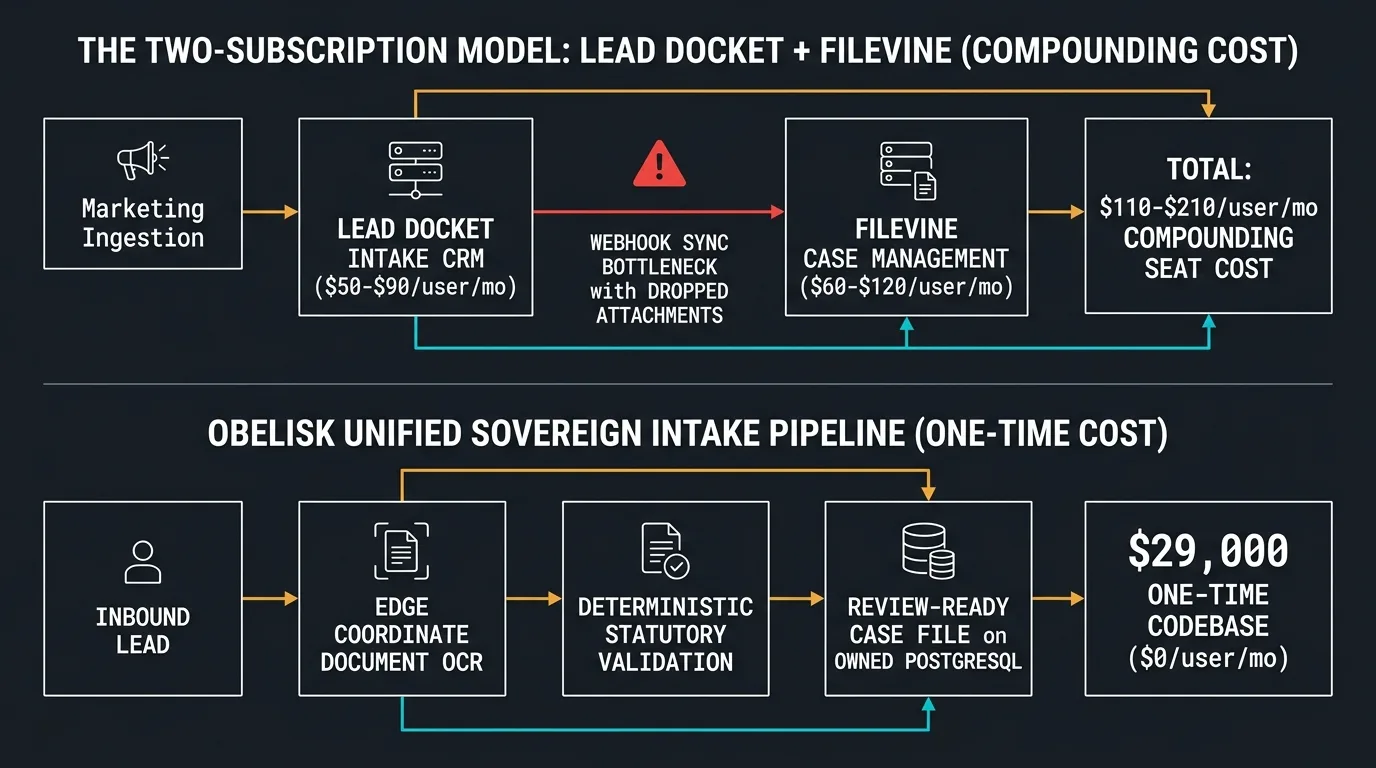
To understand why data bottlenecks occur, look at how information travels between Lead Docket and Filevine:
1. The Lead Docket Environment (Intake Front-End)
When a prospective claimant fills out an online form or calls your office, the inquiry lands in Lead Docket.
- The software records lead source attribution (Google Ads, TV, referral attorneys).
- Intake agents follow static questionnaires to determine basic eligibility.
- Automated SMS drips follow up with unanswered leads.
- The record exists inside Lead Docket's independent database schema.
2. The Conversion Handoff (The Webhook Bridge)
When an intake specialist verifies basic qualification and obtains a signed retainer, the record status changes to "Signed" or "Accepted."
This status change triggers a webhook call from Lead Docket to Filevine's API:
- Lead Docket packages the contact details and custom form fields into a JSON payload.
- Filevine creates a new Project and maps the contact as the primary client.
- Pre-configured custom section fields in Filevine populate with values mapped from Lead Docket questions.
3. Where the Webhook Synchronization Breaks
Because Filevine and Lead Docket operate on distinct databases, the integration encounters three recurring failure points in high-volume litigation:
- Dropped File Attachments: Large medical records, police reports, and photo uploads collected during intake often fail to transfer across API rate limits, forcing paralegals to manually download documents from Lead Docket and re-upload them to Filevine.
- Contact Duplication: If a claimant submits multiple web forms or calls from different phone numbers, Lead Docket frequently creates multiple unlinked records that push duplicate projects into Filevine.
- Field Schema Drift: Whenever an operations manager adds or edits a qualification question in Lead Docket, they must manually reconfigure the API field mapping inside Filevine. If a field mapping breaks, intake data silently drops into unstructured activity notes.
Stop Re-Keying Files Across Two Disconnected Systems
When webhooks drop attachments and custom fields drift, staff lose hours re-entering data. OBE eliminates API synchronization gaps by unifying intake capture and evidence review into a single record.
The Financial Reality: Compounding Double Seat Taxes
Because Filevine treats Lead Docket as an independent software product, firms pay two monthly subscription fees for team members who handle both intake and casework:
| Team Role | Lead Docket License | Filevine License | Total Monthly Software Cost Per Person |
|---|---|---|---|
| Intake Specialist | $50–$90 / mo | Not required | $50–$90 / mo |
| Case Paralegal | Not required | $60–$120 / mo | $60–$120 / mo |
| Associate Attorney | $50–$90 / mo (Review) | $60–$120 / mo | $110–$210 / mo |
| Managing Partner | $50–$90 / mo (Reports) | $60–$120 / mo | $110–$210 / mo |
| Operations Director | $50–$90 / mo (Routing) | $60–$120 / mo | $110–$210 / mo |
For a 25-person plaintiff firm where attorneys, supervisors, and operations staff need visibility across both the marketing pipeline and active case files, the combined seat licenses total $35,000 to $65,000 every single year.
Functional Comparison: Filevine vs. Lead Docket
| Feature / Capability | Lead Docket | Filevine | Obelisk (OBE Sovereign System) |
|---|---|---|---|
| Primary System Job | Marketing lead tracking and intake conversion | Case management, tasks, and litigation filings | Unified intake pipeline and automated evidence extraction |
| Document OCR & Coordinate Extraction | None (Static file storage) | Add-on module (Filevine AI fees apply) | Native edge coordinate extraction (Zero add-on fees) |
| Referral Fee Tracking | Granular referral attorney commission ledgers | Basic matter contact associations | Automated referral tracking & ledger export |
| E-Signature Workflows | Built-in e-sign for retainers | Built-in (Outlaw document integration) | Instant mobile client portal e-signature |
| Case-Type Qualification Depth | Static questionnaire fields | Dynamic litigation task flows | Case-type-defined statutory rules engine |
| Data Storage Architecture | Shared multi-tenant cloud | Shared multi-tenant cloud | Dedicated, client-owned PostgreSQL database |
| Licensing Model | $50–$90/user/mo recurring | $60–$120/user/mo recurring | $29,000 one-time owned codebase ($0/user/mo) |
Audit Your True Per-Seat Software Costs
Law firms handling active dockets often pay over $2,000 every month in compounding seat taxes for tools that still require manual data entry. Discover how OBE pairs dedicated nearshore intake pods with flat-fee codebase ownership.
Do You Actually Need Both?
Firms asking whether they need both Filevine and Lead Docket fall into one of three situations:
Scenario A: You Already Use Filevine and Need Better Intake
Filevine has native intake forms and project creation triggers, but its front-end form tools lack marketing attribution tracking, SMS cadence automation, and call center script management.
If your firm relies heavily on paid advertising (Google Ads, Meta campaigns, billboards) and manages a team of dedicated intake phone reps, Filevine alone will feel clumsy. Lead Docket solves the call script and attribution problem, but adds a second monthly subscription bill.
Scenario B: You Run High-Volume Practice Areas (Mass Tort or Consumer Arbitration)
In mass torts, consumer arbitration, or wage and hour claims, neither Lead Docket nor Filevine solves the primary operational bottleneck.
Lead Docket can record that a claimant took a drug or worked for an employer. But it cannot extract dates of usage from pharmacy records, cross-check medical diagnoses against FDA recall lists, or calculate overtime damages from paystubs.
Paralegals still end up performing hours of manual data re-entry. In high-volume litigation, pairing Lead Docket with Filevine simply moves incomplete files from one paid dashboard to another.
Scenario C: You Want an Owned, Unified Pipeline
Instead of paying two separate vendors to manage the front and back halves of your client journey, high-volume firms increasingly deploy sovereign software.
Obelisk (OBE) replaces both Lead Docket's intake forms and Filevine's manual intake data entry with a unified, owned intake pipeline.
How Obelisk Unifies Intake and Review
Obelisk operates on a different architectural philosophy: why pay two recurring software subscriptions to transfer unstructured text when code can qualify, extract, and assemble claims automatically?
Prospective Claimant (Web, Mobile, SMS)
               │
               ▼
Edge Intake Pipeline (Case-type-defined statutory logic)
               │
               ▼
Autonomous Coordinate Extraction (Medical records, contracts, bills)
               │
               ▼
Truth Hierarchy Verification (Resolves factual conflicts)
               │
               ▼
Review-Ready Case File (Attorneys review and approve with one click)
1. Zero Per-Seat Licensing
Firms pay a single $29,000 deployment fee. You never pay per-seat licenses for intake staff, paralegals, or outside review attorneys.
2. Eliminating the Webhook Bottleneck
There is no webhook sync to fail and no dropped attachments. Document extraction executes directly on ingestion, populating your firm's private PostgreSQL database.
3. Review-Ready Output
Instead of generating an empty case card that requires two weeks of paralegal follow-up, OBE produces a review-ready case file showing facts, evidence, conflicts, and missing information.
4. Audited Real-World Results
When Dallas litigation firm Bennett Legal overhauled its intake infrastructure with OBE, managing attorney Charles Bennett eliminated $87,000 per year in recurring software costs ($44,000 for Filevine, $21,000 for Moxo, and $22,000 for data-extraction pipelines, with staff and lawyer time excluded). The firm processed 642 qualified consumer arbitration intakes in six months with zero paid advertising.
Read our overview on modern legal intake or discover how we structure mass tort intake without per-seat taxes.
Summary Checklist: Making the Right Decision
- If your firm handles general litigation with modest intake volume: Filevine alone is usually sufficient. Configure Filevine's native forms and avoid the extra Lead Docket seat subscription.
- If your firm runs heavy personal injury advertising: Lead Docket provides strong marketing attribution and call center tracking, but budget for combined per-seat fees across both platforms ($110 to $210 per user per month).
- If your firm handles high-volume mass torts, consumer arbitrations, or complex statutory claims: Stop paying double seat taxes for tools that require manual data re-entry. Build a sovereign intake pipeline that extracts evidence directly and delivers review-ready case files.
Find the Right Intake Software and Developers for Your Firm
Tired of juggling multiple software subscriptions, dropped API webhooks, and manual intake cleanup?
👉  Schedule a Consultation with Tim Ottowitz to Review Your Case Type
We will inspect your current Lead Docket and Filevine workflows, audit your field mappings, and show you how a sovereign intake pipeline eliminates recurring seat fees.
Let us build your intake
Want us to build this exact intake pipeline for your firm?
Send us your intake questionnaire, retainer agreement, and document checklist. We will build, test, and deploy a custom, review-ready intake flow for your practice area.
Build My Intake Pipeline