
lead docket alternativesWhy High-Volume Plaintiff Firms Leave Lead Docket, and What to Build or Buy Instead
Lead Docket is the default intake CRM for plaintiff law firms, but per-seat fees and static web forms create bottlenecks as volume scales. An honest review of seven alternatives.
Lead Docket established itself as the standard intake CRM for plaintiff law firms for valid reasons. It brought organized tracking, automated call and text sequences, and clear pipeline stages to practices that were running intake out of shared inboxes or yellow pads. When Filevine acquired Lead Docket in April 2020, it cemented Lead Docket as the default intake front-end for thousands of litigators.
Yet high-volume plaintiff and mass tort firms increasingly outgrow the platform. When firms shop for alternatives, they are rarely complaining about phone logging. They are hitting structural boundaries in how modern intake data must be structured, verified, and owned.
Grounded in modern legal intake architecture, this guide evaluates the real alternatives. It compares reported pricing, architectural differences, visual workflow evidence, and who should simply remain on Lead Docket.
Why Law Firms Look for Lead Docket Alternatives
Firms that outgrow Lead Docket typically hit one of three distinct walls:
- The form-builder ceiling: Lead Docket captures inquiries through flat web forms and webhook connectors. For straightforward personal injury auto accidents, a static ten-field form is adequate. For complex mass torts, wage and hour claims, or multi-jurisdiction consumer disputes, static forms cannot handle dynamic statutory calculations, conditional branching, or coordinate-anchored document verification. Staff spend hours calling claimants back to collect the facts the initial form missed.
- Modular per-seat compounding: As intake call centers and case manager teams expand, per-seat software licenses multiply quickly. Third-party buyer reports place Lead Docket near $150 per user per month, plus setup fees that can reach thousands of dollars according to Capterra buyer reports. Adding 20 intake specialists can mean adding $36,000 per year just for lead forms and messaging.
- Lack of code-level ownership: When your firm discovers an emerging litigation opportunity, such as a state statutory change or consumer arbitration wave, you cannot wait months for a SaaS vendor to update their standard fields. High-volume firms need to own their qualification rules and evidence pipelines directly.
Break Free from Static Intake Scripts and Dropped Leads
Lead Docket relies on basic call scripts and rigid forms that cannot parse complex evidence. OBE structures medical records, retainer agreements, and call transcripts into verified case files.
Visualizing the Architectural Difference
The primary division in legal intake today is between legacy form capture and modern case-type-defined intake pipelines:
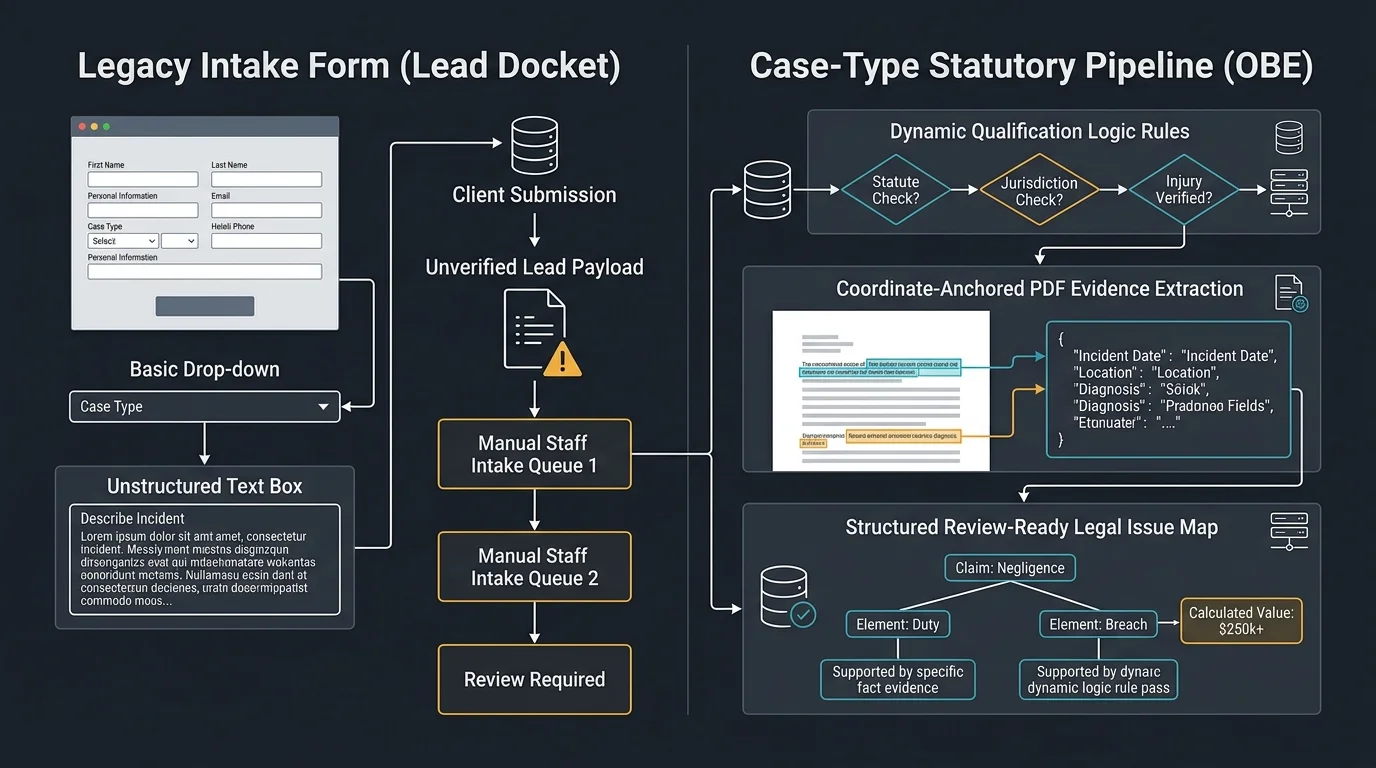
In the legacy form model on the left, an unverified web submission lands in a queue as raw text. Staff must manually open the record, dial the claimant, ask clarifying questions, and manually copy data into the case management system.
In the case-type-defined model on the right, the intake pipeline evaluates statutory rules in real time, requests necessary documents during the active session, extracts key data points directly from source PDFs, and delivers a review-ready case file showing facts, evidence, conflicts, and missing information.
What to Score in a Lead Docket Alternative
Before replacing your intake stack, evaluate every option on five operational criteria:
- Intake logic depth: Can the system evaluate jurisdictional statutes and cross-reference dates, or is it just a digital clipboard?
- Document extraction: Does it extract verified facts from uploaded PDFs and retain source provenance, or simply attach files to an email?
- Headcount economics: What is your total software cost in year three when your intake pod doubles from 10 to 20 specialists?
- Data ownership: Do you hold the source code and database keys, or are your business rules locked inside a third-party multi-tenant database?
- Ethics and compliance alignment: Does the platform architecture respect supervisory obligations under ABA Model Rule 5.3 and security baselines like NIST CSF 2.0?
The Seven Lead Docket Alternatives
1. OBE Owned Intake Pipeline
Best for: High-volume plaintiff and mass tort firms whose competitive constraint is qualification speed and custom logic ownership.
OBE delivers a production-grade intake pipeline deployed directly to your firm private cloud infrastructure under a single legal practice license at $29,000 one time, with zero recurring per-seat fees at any headcount.
Instead of treating intake as a generic CRM stage, OBE implements a case-type-defined pipeline. Dynamic statutory branching screens claimants immediately, while coordinate-anchored extraction parses uploaded retainer agreements, wage statements, and medical disclosures. Attending staff and reviewing attorneys receive a review-ready case file showing facts, evidence, conflicts, and missing information.
Honest limitations: OBE is purpose-built for qualification, evidence extraction, and matter assembly. It is not an accounting or billing tool. Firms connect it to QuickBooks, LawPay, or their core accounting systems. It also requires a firm leadership team committed to owning software rather than renting vendor roadmaps.
Skip it if: You run a solo general practice handling five new phone calls a month and do not require complex qualification logic. A basic entry-tier CRM will serve you better.
2. Captorra
Best for: Large enterprise plaintiff operations built on the Salesforce ecosystem.
Captorra is an established legal intake software platform built on Salesforce. For enterprise firms with 50 or more litigators and dedicated Salesforce administrators, Captorra provides strong custom reporting, enterprise call center distribution, and deep campaign attribution.
Honest limitations: Building on Salesforce brings enterprise complexity and enterprise expense. In addition to Captorra licensing fees, firms pay underlying Salesforce licensing costs and often require full-time internal developers to maintain workflows.
3. Law Ruler
Best for: Personal injury firms looking for built-in marketing automation and e-signature.
Law Ruler is part of the ProfitSolv legal software suite. It offers automated client follow-up sequences, marketing tracking, and integrated text messaging tailored to personal injury practices.
Honest limitations: While capable for standard personal injury questionnaires, Law Ruler struggles with non-linear statutory workflows and programmatic claim assembly. Customizations remain bounded by the vendor platform architecture.
4. Filevine Native Intake
Best for: Existing Filevine practices that want all matter data in a single vendor environment.
Following its acquisition of Lead Docket, Filevine integrated intake stages directly into its primary case management system. Firms that want zero third-party integrations and prioritize having case notes, deadlines, and intake records inside one ecosystem often find the native suite acceptable.
Honest limitations: Native Filevine intake does not solve modular billing creep. Per-seat costs for core seats, Lead Docket access, and AI document extraction modules add up quickly.
5. CASEpeer
Best for: Pure personal injury practices seeking turnkey pre-litigation workflows.
CASEpeer is an opinionated, cloud-based practice management platform engineered strictly for personal injury firms. Pricing starts around $79 per user per month. It includes native intake tracking, medical treatment management, and settlement calculators out of the box.
Honest limitations: Because CASEpeer is strictly tailored to motor vehicle collisions and slip-and-fall matters, it cannot accommodate complex mass arbitration, wage and hour audits, or multidistrict litigation.
6. SmartAdvocate
Best for: Litigators managing high case volume who require deep operational customization.
SmartAdvocate is an extraordinarily detailed case management and intake tool designed for serious plaintiff and mass tort litigators. Its intake tools allow extensive custom fields, rule-based document assembly, and automated tracking of intake referral sources.
Honest limitations: The user interface is dense, and team onboarding requires substantial investment. It feels like an operational powerhouse from the late 2010s rather than a modern, friction-free claimant interface.
7. Clio Grow
Best for: Mixed-practice firms seeking a simple, low-cost contact form and scheduler.
Clio Grow functions as the business-development front end to Clio Manage. For firms handling family law, estate planning, and simple civil matters, Clio Grow delivers polished intake forms, consultation booking links, and automated reminder emails at an affordable entry price.
Honest limitations: Clio Grow is not designed for volume plaintiff intake. It lacks conditional logic engines, programmatic document extraction, and the high-speed screening tools needed for complex mass claims.
Inspect Our Live Speed-to-Lead Response Workstation
When a qualified claimant inquires, our system engages within 60 seconds and verifies case eligibility automatically before human review.
Comparison Table: Feature Matrix and Reported Pricing
| Platform | Reported Cost Model | Intake Depth | Document Extraction | Data Ownership | Best Fit |
|---|---|---|---|---|---|
| OBE Owned Codebase | $29,000 one time, $0 per seat | Case-type statutory logic | Coordinate-anchored to PDF | 100% private cloud | High-volume plaintiff and mass tort |
| Lead Docket (Incumbent) | ~$150/user/mo plus setup | Form builder, text sequences | Attachment only | Multi-tenant SaaS | Standard PI firms on Filevine |
| Captorra | Enterprise quote plus Salesforce | Enterprise CRM workflows | Third-party plugin | Salesforce tenant | 50+ attorney enterprise operations |
| Law Ruler | Starting ~$89/user/mo | Strong marketing automation | Attachment only | Multi-tenant SaaS | Mid-size PI firms |
| CASEpeer | ~$79/user/mo | Pre-built PI intake screens | Basic templating | Multi-tenant SaaS | Pre-litigation auto accident teams |
| SmartAdvocate | Quote based on volume | Deep custom fields | Automated document merge | Multi-tenant or hosted | High-volume mass tort and PI |
| Clio Grow | ~$49/user/mo | Basic contact screening | Manual review | Multi-tenant SaaS | General mixed practices |
Pricing figures represent publicly reported ranges and third-party buyer estimates. Legal software vendors negotiate customized contracts based on module bundles and firm size.
Real World Proof: Bennett Legal Scaling 0 to 642 Intakes
The difference between renting forms and owning an intake pipeline is measurable in real firm operations.
When Bennett Legal in Dallas launched a major consumer practice targeting solar financing fraud, their workflow demanded immediate document qualification. Claimants needed to upload complex solar agreements, loan disclosures, and utility invoices. Attending staff needed to verify statutory cancellation deadlines and finance charge disclosures on the first interaction.
Attempting to run this campaign through standard rented form tools resulted in crippling software spend: Bennett Legal faced an audited annual tool expenditure of $44,000 for Filevine, $21,000 for Moxo, and $22,000 for data-extraction pipelines, totaling $87,000 per year, with staff and lawyer time excluded.
Bennett Legal replaced that fragmented stack with OBE sovereign codebase deployed to private cloud infrastructure. The firm scaled from zero to 642 review-ready intakes, with dynamic qualification logic filtering out unqualified inquiries before human review and statutory violations automatically anchored to the exact page coordinates in the claimant source PDFs.
The economics and architecture of this transition are documented in the Bennett Legal case study and explained in depth on /stop-renting.
Recommendation by Firm Situation
- "Our intake team doubled and our software bill exploded." If you are spending $30,000 or more annually on per-seat intake licenses, moving to an owned software asset solves the margin squeeze permanently.
- "We run personal injury and need a faster setup." If you want turnkey PI intake with no custom engineering, evaluate CASEpeer or Law Ruler.
- "We run Salesforce across all business units." Captorra is the logical enterprise route if you already employ Salesforce administrators.
- "We are launching a new mass tort or wage and hour docket." You need custom statutory logic and document parsing that vendor roadmaps do not support. Ownership is the only model that gives you complete control over the claimant qualification rules.
- "Our current Lead Docket setup works and our team is happy." Stay where you are. Software migrations carry real operational friction, and you should only switch when your business model hits a technical ceiling.
Frequently Asked Questions
What is the primary difference between Lead Docket and OBE?
Lead Docket is a multi-tenant cloud CRM focused on lead tracking, call logging, and automated communication drip campaigns. OBE is an owned intake codebase deployed to your private cloud that executes case-type-defined statutory qualification, extracts evidence from source PDFs, and delivers a review-ready case file showing facts, evidence, conflicts, and missing information.
How much does Lead Docket cost per month?
Lead Docket does not publish a standardized public rate card. Public buyer reports and third-party procurement data estimate pricing at approximately $150 per user per month when purchased as a dedicated intake solution, often accompanied by one-time onboarding charges ranging from $1,500 to $5,000 depending on workflow configuration.
Can Lead Docket handle coordinate-anchored PDF extraction?
No. Lead Docket stores uploaded files as matter attachments. It does not natively parse document coordinates, verify disclosures against statutory rules, or map extracted evidence lines directly to source pages.
How long does it take to deploy an owned intake pipeline?
OBE deploys a case-type-defined intake pipeline to your firm private cloud infrastructure in approximately two weeks. Your team begins with structured case data and a review-ready legal issue map tailored to your specific claim types.
Ready to evaluate your legal intake stack and eliminate per-seat licensing?
 Schedule a Consultation with Tim Ottowitz
We will examine your current intake volume, review your qualification logic, and show you exactly what an owned intake pipeline looks like in production.
Schedule a Consultation with Tim Ottowitz
We will examine your current intake volume, review your qualification logic, and show you exactly what an owned intake pipeline looks like in production.
Find the Right Intake Software and Developers for Your Firm
Looking for a modern alternative to Lead Docket without per-user seat fees?
👉 Schedule a Consultation with Tim Ottowitz to Review Your Case Type
We will inspect your current lead conversion rates, audit your attribution tracking, and show you how OBE delivers review-ready case files with zero recurring seat fees.
Let us build your intake
Want us to build this exact intake pipeline for your firm?
Send us your intake questionnaire, retainer agreement, and document checklist. We will build, test, and deploy a custom, review-ready intake flow for your practice area.
Build My Intake Pipeline