
litify alternativesEscaping the Salesforce Tax: Why Large Plaintiff Firms Leave Litify, and What to Build or Buy Instead
Litify promises enterprise scale on top of Salesforce, but six-figure implementation fees and endless consultant retainers leave high-volume firms trapped. A breakdown of seven alternatives with reported pricing and technical trade-offs.
Litify is the enterprise heavyweight in plaintiff and mass tort software. Built on top of Salesforce, it sells managing partners on the promise of infinite customization, enterprise stability, and Wall Street-grade operational scale.
For firms with 200 or more seats and a dedicated IT department, that promise can hold up. But for mid-sized and high-volume boutique firms, Litify often creates a compounding financial drain known across the industry as the Salesforce Tax.
Before your firm processes a single intake, you encounter:
- An initial implementation fee ranging from $50,000 to over $200,000 charged by certified Salesforce systems integrators.
- A mandatory deployment timeline stretching across six to twelve months.
- Stacking licensing fees where you pay both Litify per-seat rates ($200 to $450 per user per month) and underlying Salesforce platform fees.
- Perpetual reliance on third-party Apex developers billing $200 to $300 per hour for every workflow change.
When mass tort inquiries spike or high-volume consumer arbitrations arrive, multi-tenant Salesforce Governor Limits cap database queries, document uploads, and API bursts.
If your firm is evaluating alternatives to Litify or planning a migration off the platform, here is an honest technical and financial evaluation of seven alternatives for 2026.
The Real Cost of Litify: The 3-Year Enterprise TCO Breakdown
Salesforce software agreements rarely reveal their full operational cost in the initial sales demo. To evaluate real alternatives, law firm leaders must examine the entire 3-year total cost of ownership (TCO) for a standard 20-person legal practice:
| Cost Category | Litify (Salesforce Ecosystem) | Traditional Legal SaaS | Obelisk (OBE Sovereign Codebase) |
|---|---|---|---|
| Upfront Implementation & Scoping | $75,000–$150,000 (Boutique Systems Integrator) | $5,000–$15,000 (Vendor Onboarding) | $29,000 (Complete Platform Deployment) |
| User Seat Licensing (20 users) | $72,000–$108,000 / year ($300–$450/user/mo) | $24,000–$36,000 / year ($100–$150/user/mo) | $0 / month (Zero Seat Fees) |
| Salesforce Platform Add-On Fees | $12,000–$25,000 / year (Storage, API calls) | Included in base seat | Included in client cloud infrastructure |
| Custom Workflow Maintenance | $30,000–$50,000 / year (Apex developer retainers) | Vendor roadmaps only (No code access) | Direct TypeScript codebase ownership |
| 3-Year Total Investment | $357,000–$559,000+ | $92,000–$138,000 | $29,000 one-time |
When firms examine their general ledger after three years on Litify, they discover they spent more than $350,000 on software subscriptions and consultant retainers without owning a single line of intellectual property.
Avoid the Salesforce Enterprise Tax on Legal Workflows
Litify builds on Salesforce, forcing firms to pay double licensing fees and retain dedicated Salesforce administrators. OBE delivers high-volume legal intake without enterprise overhead.
Architectural Comparison: Multi-Tenant Constraints vs. Sovereign Pipeline
The friction inside Litify is structural. Because Litify sits on Salesforce, your claimant records live in a multi-tenant database governed by hard programmatic limits:
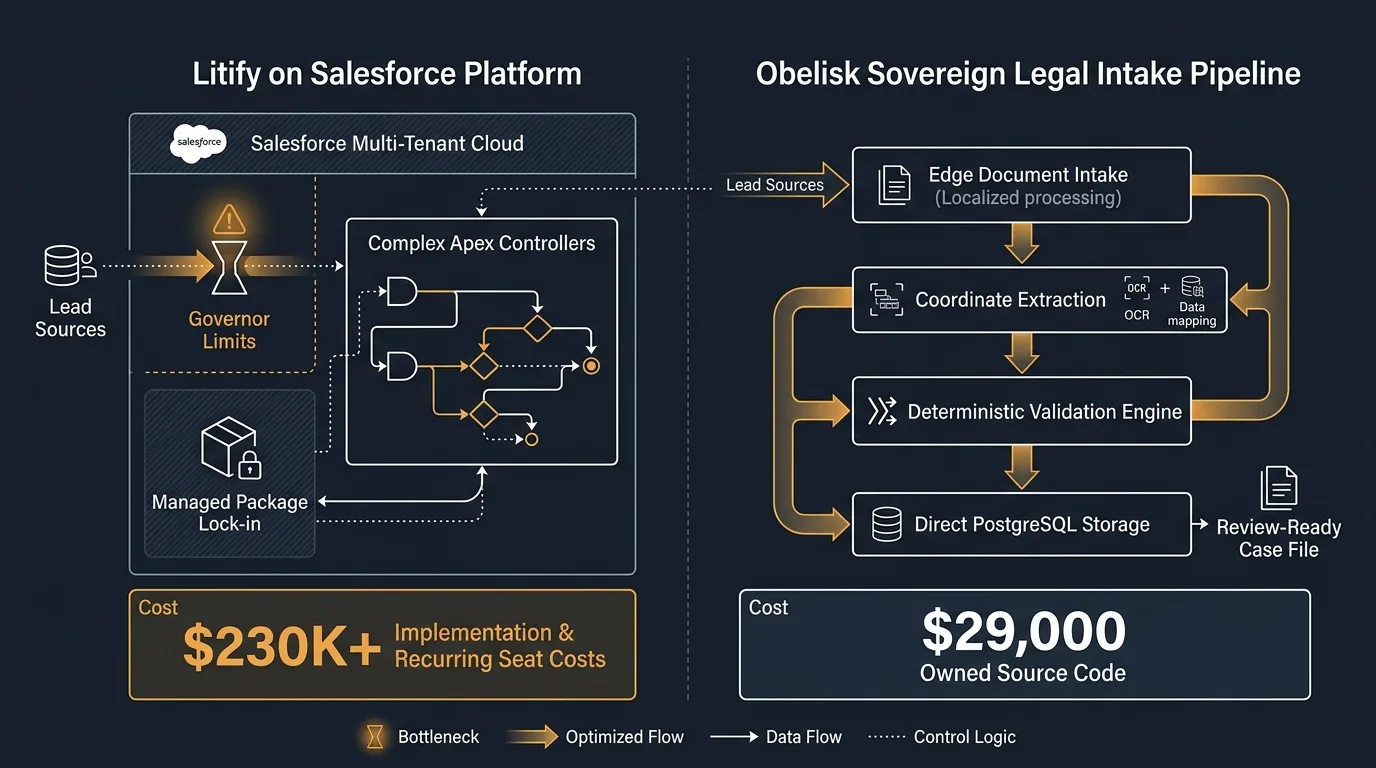
- Salesforce Governor Limits: Salesforce enforces hard limits on every transaction. SOQL queries cannot exceed 50,000 records, and heap sizes cap at 6MB for synchronous apex calls. When a mass tort campaign generates 10,000 claimant records and medical files in a single weekend, batch apex jobs fail or backlog.
- Managed Package Black Boxes: Litify logic is distributed as a managed package. You cannot inspect or modify core objects directly. When a custom intake workflow conflicts with Litify base triggers, you must wait for official patch releases.
- Sovereign Intake Pipelines: Obelisk (OBE) replaces multi-tenant abstractions with a sovereign, dedicated intake pipeline. Document ingestion and coordinate extraction execute at the edge, writing directly to an isolated PostgreSQL database. The output is a review-ready case file showing facts, evidence, conflicts, and missing information, delivered directly to attorneys without seat taxes.
1. Obelisk (OBE): The Sovereign Intake Pipeline and Owned Codebase
Obelisk is not another subscription CRM. It is a sovereign legal intake system where the firm pays a single $29,000 deployment fee and receives complete ownership of the production codebase, database schemas, and edge infrastructure.
Incoming Lead / Referral
         │
         ▼
Edge Ingestion Worker (Sub-second qualification)
         │
         ▼
Coordinate Document Extraction (OCR + Evidence Mapping)
         │
         ▼
Deterministic Fact Verification & Conflict Check
         │
         ▼
Review-Ready Case File (Attorneys click to review and e-sign)
Key Technical Differences
- Zero Seat Licenses: Whether your firm employs 5 staff or 150 paralegals and contract intake reviewers, your software cost remains $0 per user per month.
- Direct Database Ownership: All claimant records, medical disclosures, retainers, and communication histories sit in an isolated PostgreSQL instance owned by your firm, not in a shared vendor cloud.
- Review-Ready Output: Instead of dumping raw form responses into endless CRM tabs, OBE produces a review-ready case file showing facts, evidence, conflicts, and missing information.
- Empirical Proof: When Dallas litigation firm Bennett Legal replaced its fractured software stack with OBE, managing attorney Charles Bennett eliminated $87,000 per year in recurring software costs ($44,000 for Filevine, $21,000 for Moxo, and $22,000 for data-extraction pipelines, with staff and lawyer time excluded). The firm processed 642 qualified consumer arbitration intakes in six months with zero paid advertising.
Who It Fits
Firms with 10 to 100 staff processing high-volume personal injury, consumer arbitration, or mass tort matters who want to escape monthly SaaS taxes and own their operational infrastructure.
Explore how our modern approach to legal intake replaces bloated enterprise subscriptions with an owned codebase.
2. Filevine
Filevine is the most frequent cloud destination for firms leaving Litify. It provides deep task management, automated document generation, and legal-specific workflow orchestration without requiring a Salesforce developer certification.
Honest Strengths
- Deep native features for litigation workflows, deadlines, and trial tracking.
- Pre-built document assembly tools (Outlaw) and activity feeds.
- Large partner ecosystem and native integrations with legal accounting tools.
Operational Limitations
- Compounding per-seat pricing ($50 to $120+ per user per month) with annual contracts and automatic price increases.
- Separate per-seat billing for intake via Lead Docket ($50 to $90 per user per month).
- Advanced document extraction and AI add-ons (Filevine AI) carry separate usage charges.
Who It Fits
Firms seeking a mature, full-featured cloud case management system that do not have the internal technical staff to support Salesforce.
3. SmartAdvocate
SmartAdvocate is an established, feature-dense case management platform built specifically for plaintiff litigation and mass tort practices.
Honest Strengths
- Extremely granular personal injury and mass tort reporting out of the box.
- Over 2,000 pre-configured report templates and detailed settlement distribution calculators.
- Available as both a cloud-hosted SaaS platform and a self-hosted private server installation.
Operational Limitations
- Interface feels outdated and complex compared to modern web applications.
- Steep learning curve for intake specialists and operational staff.
- Additional costs for add-on modules, SMS packages, and custom integrations.
Who It Fits
Firms handling complex personal injury, medical malpractice, and mass tort litigations that value deep reporting over modern interface design.
4. Lead Docket
Lead Docket (owned by Filevine) is a dedicated legal intake CRM designed to track incoming marketing leads, manage intake specialist call scripts, and optimize referral fees.
Honest Strengths
- Superior lead tracking, marketing source attribution, and intake conversion reporting.
- Automated follow-up cadences via SMS and email to maintain speed to lead.
- Strong referral network tracking for co-counsel fee distributions.
Operational Limitations
- Lead Docket is an intake front-end, not a full litigation case management system. Firms must integrate it with Filevine, Clio, or SmartAdvocate to run active cases.
- Rigid static form questions that struggle to adapt to complex case-type-defined statutory qualification logic.
- Per-seat fees create incentives to limit intake software access to a small subset of staff.
Who It Fits
Plaintiff firms that already run Filevine or another case management backend and need a disciplined intake call center tool.
Inspect Our High-Volume Mass Tort and Arbitration Engine
Processing 5,000 active claims in Salesforce triggers severe API governor limits. OBE's reactive Convex database handles thousands of concurrent filings with sub-second latency.
5. CASEpeer
CASEpeer is a turnkey, cloud-based practice management platform engineered specifically for personal injury firms.
Honest Strengths
- Zero setup configuration required: motor vehicle accident (MVA) workflows, settlement tracking, and medical record requests work on day one.
- Clean, intuitive interface that paralegals and legal assistants adopt quickly.
- Built-in client texting and e-signature tools.
Operational Limitations
- Hardcoded for standard personal injury: difficult or impossible to configure for complex mass tort, consumer arbitration, or employment class actions.
- Document extraction is manual: staff must open PDFs and hand-type medical billing figures into database fields.
- Per-user monthly fees ($79 to $129 per seat) compound as support staff grows.
Who It Fits
Small to mid-sized firms that focus exclusively on motor vehicle accidents and slip-and-fall cases and want zero implementation overhead.
6. Clio Manage & Clio Grow
Clio is the largest practice management platform in the world by market share, offering Clio Manage for casework and Clio Grow for client intake.
Honest Strengths
- Industry-standard reliability, security certifications, and clean user experience.
- Massive third-party app directory with hundreds of integrations.
- Tiered pricing ($49 to $149 per user per month) suitable for solo practitioners and growing firms.
Operational Limitations
- Built for general practice law: lacks native high-volume mass tort, complex settlement matrices, and multi-claimant deduplication tools.
- Clio Grow intake forms are simple web questionnaires with no real-time coordinate document parsing.
- Requires extensive third-party zapier automations to match enterprise workflows.
Who It Fits
General practice firms and boutique litigation shops handling modest case volume across varied practice areas.
7. Custom In-House Engineering Stack
A growing number of large litigation practices choose to hire contract software developers to build custom intake and case management software on AWS or Azure.
Honest Strengths
- 100% bespoke functionality tailored to your firm's specific dispute rules and intake questionnaires.
- Complete data privacy and exemption from third-party vendor shutdowns.
Operational Limitations
- High upfront capital risk: custom software projects regularly exceed $150,000 to $300,000 before reaching production stability.
- Ongoing maintenance liability: when the original freelance developer moves on, the firm inherits technical debt with no warranty.
- Security and compliance burdens (SOC2, HIPAA, state bar data ethics) rest entirely on firm partners.
Who It Fits
Firms with dedicated internal software engineering talent, permanent development budgets, and proprietary litigation strategies.
Comparison Matrix: Feature and Ownership Breakdown
| Feature / Metric | Litify | Filevine | SmartAdvocate | CASEpeer | Obelisk (OBE) |
|---|---|---|---|---|---|
| Base Tech Platform | Salesforce Cloud | Proprietary Cloud | AWS or Private Server | Proprietary Cloud | Sovereign Edge + PostgreSQL |
| Typical Monthly Seat Tax | $300–$450/user | $50–$120/user | $80–$120/user | $79–$129/user | $0 / month |
| Implementation Overhead | $50K–$150K+ (Months) | $5K–$20K (Weeks) | $5K–$15K (Weeks) | Zero (Days) | $29,000 (Complete) |
| Multi-Tenant Limits | Hard Governor Limits | Vendor Capped | Server Dependent | Vendor Capped | Zero (Isolated Instance) |
| Coordinate Document OCR | Add-on / Third-Party | Add-on (Filevine AI) | Manual Entry | Manual Entry | Native Edge Pipeline |
| Code Ownership | Rented Salesforce Package | 100% Rented SaaS | Rented License | 100% Rented SaaS | 100% Client-Owned Code |
| Review-Ready Case Files | Multi-tab form records | Activity feed notes | Matter fields | Form summary | Structured Review File |
How to Decide Which Alternative Fits Your Firm
Before signing another multi-year enterprise software contract, run your firm through these three architectural questions:
1. Are You Paying for Salesforce Features You Never Touch?
If your firm only uses basic custom objects, task routing, and email templates, you are paying a 300% premium for the Salesforce brand. Filevine or SmartAdvocate provide litigation workflows at a fraction of the cost, while OBE eliminates the seat tax entirely.
2. Is Your Intake Team Bottlenecked by Manual Data Re-Entry?
If your intake staff spends hours copying medical bills, police report numbers, and contract terms from PDFs into CRM form fields, you do not have a case management problem. You have a document extraction bottleneck. Switching from Litify to another traditional CRM will not solve it. You need a dedicated mass tort intake or litigation pipeline with coordinate extraction.
3. Do You Want to Rent or Own Your Infrastructure?
Every dollar spent on Litify, Filevine, or CASEpeer is operational expense that disappears at the end of the billing cycle. An owned software codebase turns legal technology into a balance sheet asset that increases the enterprise value of your firm.
Take the Next Step
If you are frustrated by compounding seat taxes, slow implementation consultants, and multi-tenant bottlenecks, we can help you evaluate your options.
Find the Right Intake Software and Developers for Your Firm
Looking for enterprise-grade intake power without Salesforce complexity?
👉  Schedule a Consultation with Tim Ottowitz to Review Your Case Type
We will review your custom object structures, evaluate your API throughput requirements, and show you how a sovereign intake pipeline delivers review-ready files without seat taxes.
Let us build your intake
Want us to build this exact intake pipeline for your firm?
Send us your intake questionnaire, retainer agreement, and document checklist. We will build, test, and deploy a custom, review-ready intake flow for your practice area.
Build My Intake Pipeline