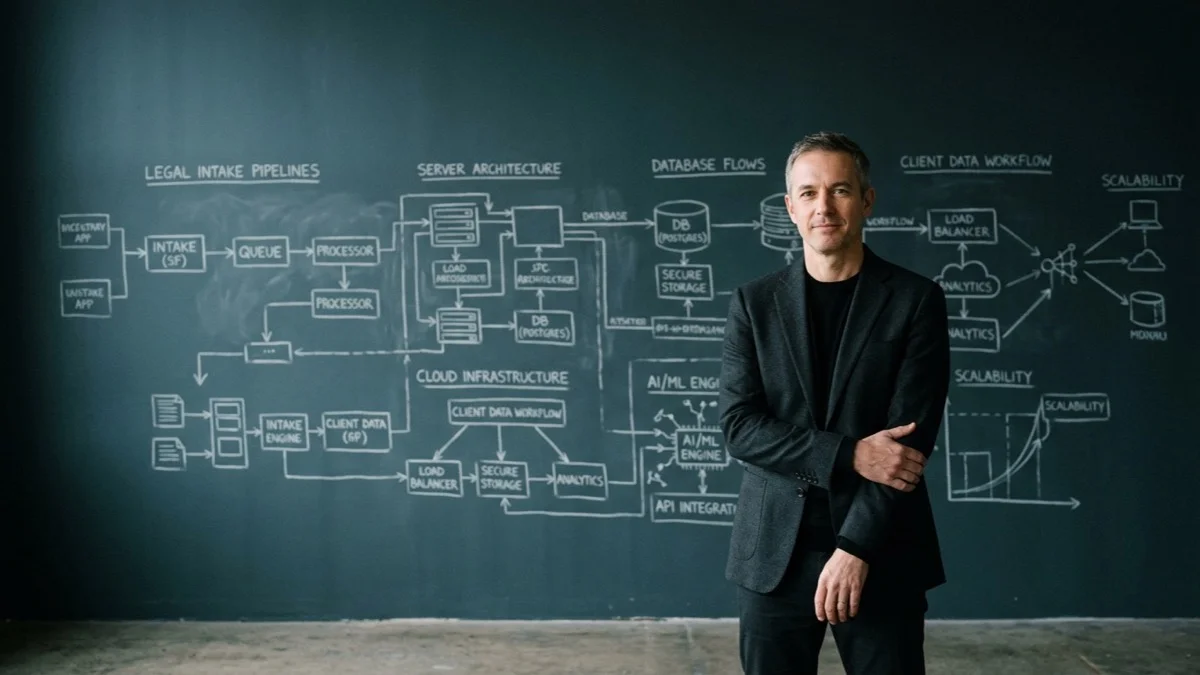
legal intake software us vs themUs vs. Them: Why Elite Litigation Firms Buy Their Legal Intake Software Instead of Paying $87,000 in SaaS Rent
Why litigation firms are escaping the $87,000 annual SaaS rent cycle by buying an owned 3-in-1 legal intake engine, running on a $30 server with per-case MCP sandboxes.
Congratulations on finding this page. If you work for a growing law firm searching for legal intake software that you can fully own for a one-time setup payment, host on a $30-per-month US-based server, and use to permanently end the cycle of escalating SaaS subscriptions, you have reached the right place.
Managing partners and legal operations leaders face an artificial dilemma when upgrading their intake operations.
On one side, legacy legal CRMs offer pre-built forms wrapped in perpetual seat licensing. On the other side, firms attempt to code custom scripts or stitch together brittle no-code automations that collapse under evidentiary volume.
Two years ago, I faced this exact problem as CTO at Bennett Legal, a litigation practice in Dallas, Texas. Our firm was spending $87,000 every single year across a fragmented software stack: Filevine seat fees, Moxo client portal workflows, and third-party document extraction tools. Staff and lawyer time were separate.
We sat down, examined the balance sheet, and asked a simple question: What happens if we spend eighteen months with a dedicated engineering team to build a sovereign, three-in-one system that we own outright?
The result was an engine that automatically extracts key case facts from evidentiary documents, captures incoming leads from Meta ads and organic web forms without Zapier middleware, and qualifies every claimant against deterministic legal criteria.
Grounded in our sovereign software architecture, here is the direct breakdown of us vs. them: why renting commercial legal software costs your firm tens of thousands in unrecoverable capital, how an owned intake engine operates, and why modern per-case AI sandboxes change how attorneys practice law.
The $87,000 Question: Software Rent vs. Human Talent
Before evaluating features, look at your general ledger.
At Bennett Legal, our audited annual intake software expenditures looked like this:
- Filevine Core Licenses and User Seats: $44,000 per year
- Moxo Client Workflows and Document Portals: $21,000 per year
- Third-Party OCR and Document Extraction Pipelines: $22,000 per year
- Total Annual Software Rental: $87,000 per year, before staff and lawyer time
Every time the firm hired an associate, a paralegal, or an intake specialist, the software landlords issued another seat tax. When our lead volume doubled during high-volume consumer arbitration campaigns, per-submission usage fees surged alongside it.
The core financial reality: Eighty-seven thousand dollars represents an enormous sum. It equals the full annual compensation of an experienced full-time legal assistant or paralegal dedicated exclusively to communicating with your clients, sorting case records, and accelerating settlements.
When you rent commercial SaaS, that capital vanishes into a vendor's recurring revenue multiple. When you purchase an owned intake foundation, your firm makes a one-time investment, deploys the platform on a private virtual server costing roughly $30 per month (such as a dedicated Contabo or AWS instance in the United States), and redirects that $87,000 directly back to firm headcount or partner distributions.
We install and configure the entire system end-to-end for your practice for $2,500. Our internal engineering team structures your custom case types directly into the platform so that the software mirrors your exact intake rubric on day one.
Stop Paying Monthly Rent on Your Core Law Firm Workflows
Traditional legal software vendors force you into perpetual monthly subscriptions that increase every year. OBE provides permanent codebase ownership with zero seat fees.
The 3-in-1 Sovereign Intake Engine
Commercial intake vendors sell separate point solutions: one tool for landing page forms, another for document upload portals, a third for automated text extraction, and a fourth for CRM pipeline management.
Our sovereign platform consolidates these fragmented systems into a unified 3-in-1 data pipeline:
┌────────────────────────────────────────────────────────────────────────┐
│                   THE 3-IN-1 SOVEREIGN INTAKE PIPELINE                  │
└────────────────────────────────────────────────────────────────────────┘
 [ Meta Ads / Webhook ] ──┐
 [ Organic Search Form ] ──┼──>  [ Stage 1: Ingestion Engine ]
 [ Direct File Upload ]  ──┘                 │
                                             ▼
                                 [ Stage 2: Fact Extraction ]
                                 • Bounding-box PDF coordinates
                                 • Disclosures & loan rates
                                 • Contract execution dates
                                             │
                                             ▼
                                 [ Stage 3: Deterministic Rules ]
                                 • Statute of limitations check
                                 • Target defendant arbitration clause
                                 • Financial threshold validation
                                             │
                                             ▼
                                 [ Deep Case Map & MCP Sandbox ]
1. Multi-Channel Lead Ingestion
The platform exposes direct, webhook-native endpoints for Meta Instant Forms, Google Ads landing pages, and website qualification quizzes. Inquiries enter the firm's database in sub-second time. There is no Zapier middleware to break, no third-party data aggregator logging your claimant records, and no delay in your speed to lead.
2. Automated Evidentiary Fact Parsing
When claimants upload loan agreements, utility bills, or retail installment contracts, the ingestion pipeline parses each file immediately. Key case facts, including principal loan amounts, APR calculations, cosigner identities, and execution dates, are extracted deterministically. Every extracted data point remains permanently anchored to its exact page coordinate in the source PDF.
3. Rule-Based Legal Qualification
Instead of dumping raw form responses into an unorganized inbox, the engine evaluates each matter against your firm's strict qualification rubric.
We battle-tested this architecture as an MVP for solar panel fraud claims within consumer arbitration intake. The system cross-referenced the installation address against licensed installer registries, checked the retail installment contract for mandatory arbitration clauses, calculated statutory deadlines under Texas finance law, and flagged predatory escalation clauses before an intake specialist ever picked up the phone.
The operational impact of this workflow is documented in our Bennett Legal case study, where the practice scaled from zero to 642 qualified claimant intakes without adding administrative headcount.
Us vs. Them: Architectural Comparison
The difference between sovereign legal software and commercial SaaS is not cosmetic. It is structural. The table below compares OBE's owned foundation against traditional legal intake vendors like Filevine and Lead Docket.
| Capability | Commercial SaaS Landlords (Filevine / Lead Docket) | Sovereign Owned Foundation (OBE Architecture) |
|---|---|---|
| Pricing Model | Perpetual per-seat license ($50 to $150+ per user per month) plus module fees | One-time setup ($2,500) plus $30 per month private server |
| Hosting & Infrastructure | Multi-tenant shared vendor cloud | Dedicated private server (US-based Contabo or private cloud) |
| Code & Logic Ownership | Zero. Closed-source vendor property | Pure TypeScript application deployed directly on your infrastructure |
| Document Fact Extraction | Generic OCR add-on with per-page usage surcharges | Built-in coordinate-anchored parsing pipeline |
| Lead Ingestion | Requires Zapier, Make, or custom API subscriptions | Direct native webhooks for Meta, Google, and web forms |
| AI Workspaces & Sandboxes | Locked proprietary chatbot inside vendor UI | Isolated per-case sandbox with native MCP tool calling |
| Case Management Interop | Walled garden pushing you into their ecosystem | Deep Case Map export plus direct API sync to Clio, Filevine, etc. |
| Data Sovereignty | Client data pooled on multi-tenant vendor servers | Single-tenant database under strict firm encryption keys |
Inspect Our Dedicated Nearshore Intake Specialist Pods
Pair your software with dedicated, bilingual intake specialists managed directly under your firm's standard operating procedures for a flat $2,450 per month.
You Keep Clio, Filevine, or Litify: The Deep Case Map
A common question managing partners ask is: "We already use Clio, Filevine, Harvey, or Litify for case management. Does switching our intake mean migrating our entire firm database?"
The answer is no. Our legal intake software is engineered specifically to complement your core practice management suite, not force an unwanted migration.
Our platform introduces the concept of the Deep Case Map:
- Structured JSON Extraction Trees: Every evidentiary document, claimant answer, and timeline fact compiles into an open, validated JSON data structure.
- Document Coordinate Map: An index detailing exactly which fact was found in which document, including page numbers and pixel bounding boxes.
- Mirrored File System Export: Files organize automatically into directory trees matching your firm's exact folder naming conventions, such as
/Client_LastName_CaseID/01_Contracts/and/02_Disclosures/. - Direct API Synchronization: We configure an API attachment that pushes qualified, review-ready claimant dossiers directly into your existing case management database.
Your intake team works in a fast, dedicated pipeline engineered for conversion and extraction. Once a claimant qualifies and signs an engagement agreement, the entire package lands cleanly inside your existing litigation software with zero manual data re-entry.
The Kicker: Per-Case Sandboxes and Model Context Protocol (MCP)
Here is where the architecture changes the game for modern legal operations.
If your attorneys and staff are already moving to advanced AI environments like Claude Cowork, ChatGPT, or developer harnesses like Codex, this software was built for you.
For every active matter, the platform provisions an isolated case sandbox equipped with a native Model Context Protocol (MCP) server.
┌────────────────────────────────────────────────────────────────────────┐
│                   PER-CASE MCP SANDBOX ARCHITECTURE                    │
└────────────────────────────────────────────────────────────────────────┘
 [ Attorney or Paralegal ]
          │
          ▼  (Conversational Query in Claude Cowork / ChatGPT)
 ┌──────────────────────────────────────────────────────────────────────┐
 │                      ISOLATED CASE SANDBOX                           │
 │                                                                      │
 │   [ Model Context Protocol (MCP) Server ]                            │
 │   • Tool Call: search_case_documents(query)                         │
 │   • Tool Call: get_financial_extraction(field)                       │
 │   • Tool Call: verify_arbitration_clause()                          │
 │                                                                      │
 │   [ Coordinate-Linked Evidentiary Layer ]                            │
 │   • Retail Installment Contract (Page 4, ¶ 12)                       │
 │   • Truth in Lending Disclosure (Page 2, Box B)                      │
 │   • Direct Audio Intake Transcript                                   │
 └──────────────────────────────────────────────────────────────────────┘
The MCP server provides authorized LLM clients with pre-configured tools designed specifically for legal analysis. Instead of copying and pasting sensitive client files into generic chat windows, your staff interacts directly with the matter's data layer:
- Conversational Verification: An associate can open Claude or ChatGPT and type: "Verify the finance charge in Box 3 of the Truth in Lending disclosure against the total promissory note balance."
- Coordinate-Grounded Retrieval: The MCP tool reads the structured extractions and raw file coordinates, returning the exact dollar discrepancy along with the citation to page and paragraph.
- Strict Role-Based Authorization: Firm administrators grant access to specific team members per sandbox. Staff members only see the cases they are assigned to handle.
- Complete Confidentiality: In compliance with ABA Model Rule 1.6 (Confidentiality of Information), data stays within your private server perimeter. Case records are never exposed to public training sets.
Your team never has to leave their preferred chat interface. They gain real-time access to static PDF attachments, the deep extraction graph, and the reasoning layer behind every claim.
Take Ownership of Your Firm's Software Foundation
Law firms do not rent their client trusts, and they should not rent their core operational infrastructure.
Continuing to pay $87,000 per year for commercial intake platforms and generic CRM add-ons drains the capital you need to expand your litigation docket. By investing in an owned software foundation, your firm acquires a permanent technological asset:
- Eliminate Software Rent: Run your entire intake qualification engine on a $30 per month private server with zero per-user seat taxes.
- Accelerate Speed to Lead: Capture inquiries across Meta, web forms, and advertising channels with sub-second qualification.
- Automate Document Fact Extraction: Extract facts deterministically and pass clean files directly into Clio, Filevine, or Litify.
- Deploy Case-Level AI: Give your attorneys instant access to per-case MCP sandboxes in Claude Cowork and ChatGPT.
To see our 3-in-1 intake architecture in action and discuss configuring custom case types for your practice,  schedule a direct technical demo call with our engineering team today.
Find the Right Intake Software and Developers for Your Firm
Ready to stop renting software and own your firm's intake engine?
👉 Schedule a Consultation with Tim Ottowitz to Review Your Case Type
We will review your current software invoices, audit your field mappings, and show you how permanent codebase ownership eliminates recurring seat taxes forever.
Let us build your intake
Want us to build this exact intake pipeline for your firm?
Send us your intake questionnaire, retainer agreement, and document checklist. We will build, test, and deploy a custom, review-ready intake flow for your practice area.
Build My Intake Pipeline