
casepeer alternativesWhy Scaling Plaintiff Firms Leave CASEpeer, and What to Build or Buy Instead
CASEpeer provides pre-litigation auto accident structure, but per-seat fees and rigid practice-area limits create barriers as firms scale. An honest review of seven options.
CASEpeer earned a loyal following among personal injury litigators by giving firms opinionated out-of-the-box templates. Instead of forcing attorneys to spend months building custom screens for property damage, medical treatment tracking, and insurance adjusters, CASEpeer provided pre-built tabs tailored to motor vehicle collisions.
However, as personal injury firms grow beyond their initial staff or expand into multi-practice litigation, CASEpeer rigid design often becomes a bottleneck. When practices look for alternatives, they are usually responding to practice-area boundaries, compounding seat fees, or the need to automate document intake.
Grounded in modern legal intake architecture, this guide evaluates the seven leading CASEpeer alternatives. It details reported pricing, operational differences, visual workflow evidence, and which firms should simply remain on CASEpeer.
The Three Walls Firms Hit With CASEpeer
Firms leaving CASEpeer typically describe three specific constraints:
- The single-practice silo: CASEpeer is engineered specifically for personal injury pre-litigation. If your firm decides to launch a mass tort practice, wage and hour arbitration claims, or consumer fraud lawsuits, CASEpeer cannot accommodate those workflows. The tabs for vehicle damage, adjusters, and bodily injury do not translate to wage statements or statutory lending disclosures.
- Compounding seat fees: According to Capterra buyer reports, CASEpeer pricing begins around $79 per user per month, with higher tiers reaching $109 to $129 per user per month. As a practice expands its intake specialists, case managers, and medical records clerks, annual software spend scales steeply. A 20-person firm spends over $26,000 each year merely renting access to case cards.
- Manual document entry: CASEpeer stores uploaded medical records and police reports as file attachments. It does not extract treatment dates, medical billing lines, or statutory violations directly from the source PDF. Staff must open each record and manually type values into case tabs.
Upgrade Personal Injury Intake with Real-Time Speed to Lead
CASEpeer handles standard personal injury tracking but lacks automated speed-to-lead qualification. OBE engages claimants within seconds and verifies accident details instantly.
Visualizing the Difference: Siloed CRM vs Case-Type Pipeline
The fundamental split in plaintiff litigation technology separates rigid pre-litigation tabs from case-type-defined intake pipelines:
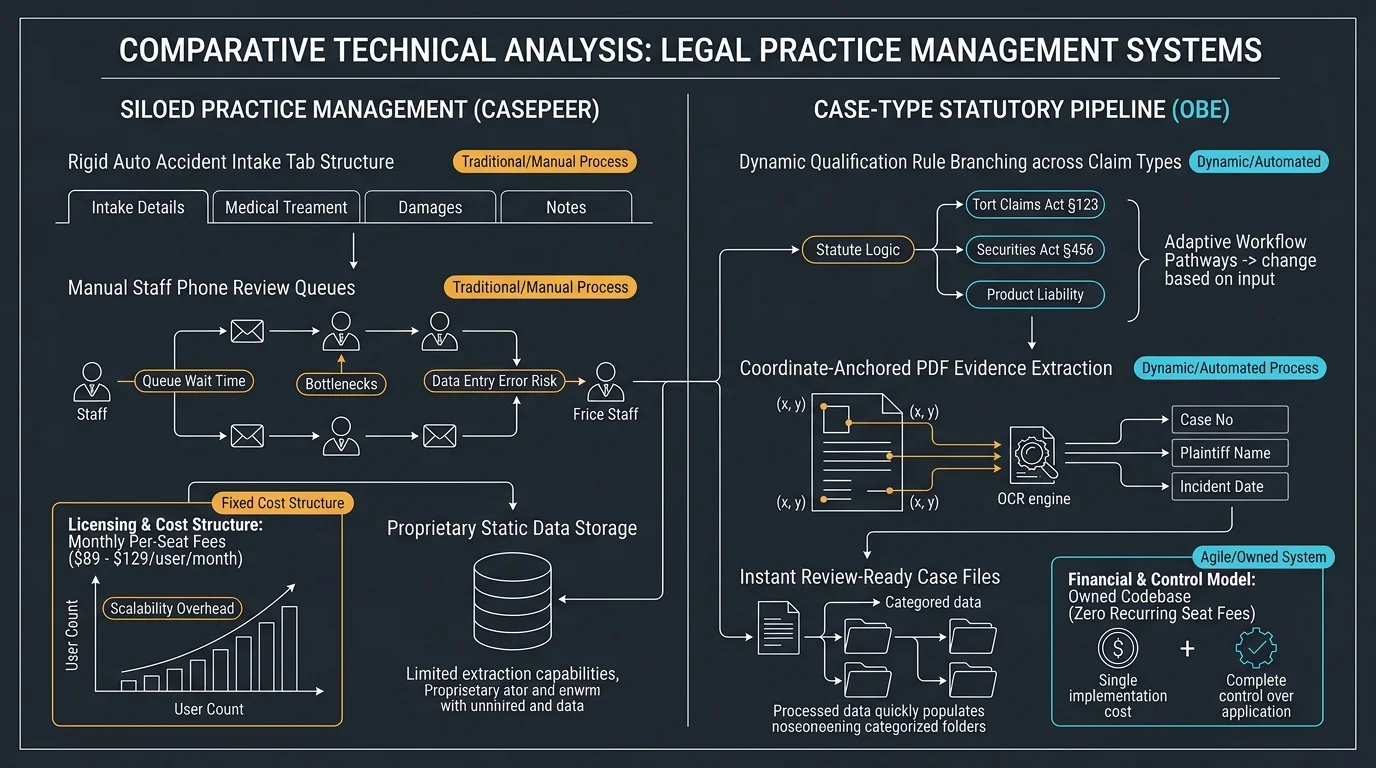
In the siloed model on the left, incoming leads queue for manual phone interviews. Staff manually key medical records into rigid auto-accident tabs while per-seat licensing fees compound as headcount grows.
In the case-type-defined model on the right, dynamic qualification rules evaluate statutory elements automatically. Coordinate-anchored extraction parses uploaded medical documents and invoices, highlighting values directly on the source PDF. Reviewing attorneys receive a review-ready case file showing facts, evidence, conflicts, and missing information under a single owned codebase license.
What to Score in a CASEpeer Alternative
Before switching practice management systems, evaluate options against five operational standards:
- Practice versatility: Can the system handle personal injury, mass tort, and statutory arbitration within one architecture?
- Document extraction: Does it automatically extract verified data from medical PDFs, or does it require manual keying?
- Long-term cost trajectory: What is your cumulative software spend over three years as your team adds case managers?
- Supervisory alignment: Does the workflow support supervisory compliance under ABA Model Rule 5.3?
- Infrastructure security: Can the software be isolated in a dedicated private environment mapped to NIST CSF 2.0?
The Seven Leading CASEpeer Alternatives
1. OBE Owned Intake and Case Codebase
Best for: High-volume plaintiff and litigation firms that want to own their operational logic and run multiple claim types without per-seat licensing.
OBE replaces rented SaaS platforms with an owned case-type-defined intake pipeline deployed directly into your firm private cloud infrastructure under a single legal practice license at $29,000 one time, with zero per-seat fees at any headcount.
Instead of locking litigators into fixed auto-injury tabs, OBE provides flexible statutory qualification logic. It screens incoming leads against matter-specific rules, extracts evidentiary facts from uploaded PDFs with coordinate-anchored accuracy, and presents counsel with a review-ready case file showing facts, evidence, conflicts, and missing information.
Honest limitations: OBE focuses on qualification, evidence extraction, and matter assembly. It does not provide built-in payroll, trust accounting, or time-tracking widgets. Practices connect it to QuickBooks, LawPay, or external accounting tools for back-office administration.
Skip it if: You operate a two-person pre-litigation auto practice with no desire to handle custom claim types or manage private cloud software. CASEpeer turnkey setup is faster for very small teams.
2. Filevine
Best for: Expanding personal injury firms that need deep task management and deadline calendaring.
Filevine is a popular choice for personal injury firms outgrowing CASEpeer. It offers custom section creation, automated deadlines, and document generation tools.
Honest limitations: Filevine involves higher base licensing costs, typically ranging from $49 to over $150 per user per month according to Costbench software reporting, plus additional fees for Lead Docket and AI extraction modules.
3. SmartAdvocate
Best for: High-volume plaintiff practices that require detailed operational reports and litigation tracking.
SmartAdvocate is designed specifically for plaintiff litigators who process large caseloads. It includes deep case tracking, litigation management, and built-in text messaging.
Honest limitations: The interface is dense and features a steep learning curve. Training staff takes significant time compared to CASEpeer simple interface.
4. CloudLex
Best for: Small to mid-sized personal injury teams seeking a modern cloud interface focused strictly on civil litigation.
CloudLex focuses exclusively on plaintiff litigation. It offers matter tracking, medical treatment logs, and a clean interface tailored to trial lawyers.
Honest limitations: CloudLex shares CASEpeer practice-area constraints. It will not adapt easily to non-injury claims such as consumer arbitration or wage disputes.
5. Assembly Neos
Best for: Established practices migrating from legacy Needles or TrialWorks on-premises servers.
Neos is the cloud-based evolution of Needles and TrialWorks. For firms with decades of historical data stored in Needles databases, Neos provides a direct migration path.
Honest limitations: Neos reflects its legacy origins in its interface and workflow configurations. Pricing starts near $109 per user per month.
6. Litify
Best for: Large enterprise plaintiff law firms with dedicated internal IT and Salesforce administration.
Built on the Salesforce platform, Litify provides enterprise reporting, cross-department intake distribution, and custom dashboards.
Honest limitations: Litify requires substantial capital investment and full-time Salesforce administration, putting it outside the practical budget of small and mid-sized practices.
7. Clio Manage
Best for: Mixed general practices that handle occasional personal injury alongside estate, family, or criminal law.
Clio Manage is the most widely adopted practice management system in North America. It provides clean billing, trust accounting, and calendaring at an accessible price point starting around $49 per user per month.
Honest limitations: Clio lacks specialized personal injury workflows like medical ledger tracking and settlement distribution sheets without third-party plugins.
Audit Your Speed to Retainer Conversion Metrics
In personal injury, reaching a claimant within 5 minutes increases retainer signing rates by over 300 percent. See how our dedicated intake pods handle calls and intake 24/7.
Comparison Table: Feature Matrix and Reported Costs
| Platform | Reported Cost Model | Practice Scope | Document Extraction | Data Ownership | Best Fit |
|---|---|---|---|---|---|
| OBE Owned Codebase | $29,000 one time, $0 per seat | PI, Mass Tort, Arbitration | Coordinate-anchored to PDF | 100% private cloud | High-volume plaintiff and mass tort |
| CASEpeer (Incumbent) | ~$79 to $129/user/mo | Personal injury only | Manual keying | Multi-tenant SaaS | Small pre-litigation auto firms |
| Filevine | ~$49 to $150+/user/mo | Broad civil litigation | Add-on AI module | Multi-tenant cloud | Mid-size plaintiff practices |
| SmartAdvocate | Quote based on volume | High-volume PI and mass tort | Automated document merge | Multi-tenant or hosted | Large litigation firms |
| CloudLex | Quote based on seats | Personal injury focus | Basic file attachment | Multi-tenant SaaS | Trial-focused PI practices |
| Assembly Neos | ~$109/user/mo | General plaintiff | Basic templating | Multi-tenant cloud | Needles migration practices |
| Clio Manage | Starting ~$49/user/mo | General practice | Plugin dependent | Multi-tenant SaaS | Mixed general practices |
Pricing data reflects publicly available buyer reports and estimated industry ranges. Specific contracts vary based on firm seat volume and module selections.
Real World Proof: Bennett Legal Scaling 0 to 642 Intakes
The operational limit of rented case management appears when a firm moves beyond basic auto accident claims into complex mass consumer disputes.
When Bennett Legal in Dallas launched a consumer litigation campaign addressing solar financing fraud, their workflow demanded instant document verification. Claimants uploaded 40-page loan disclosures, utility agreements, and cancellation notices. Attending staff needed to verify cancellation rights and statutory disclosures on day one.
Attempting to run this campaign through standard rented form tools resulted in crippling software spend: Bennett Legal faced an audited annual tool expenditure of $44,000 for Filevine, $21,000 for Moxo, and $22,000 for data-extraction pipelines, totaling $87,000 per year, with staff and lawyer time excluded.
Bennett Legal replaced that fragmented stack with OBE sovereign intake pipeline deployed to private cloud infrastructure. The firm scaled from zero to 642 review-ready intakes, with dynamic qualification logic screening inquiries before human review and statutory violations automatically anchored to exact coordinates on claimant PDFs.
The architecture and financial details of this transition are documented in the Bennett Legal case study and outlined on /stop-renting.
Recommendation by Firm Situation
- "Our software bill is growing faster than our revenue." If you have more than 15 staff members and pay over $20,000 annually in per-seat CRM licenses, moving to an owned software asset permanently eliminates seat fees.
- "We exclusively handle auto accidents and want simple setup." Stay with CASEpeer. Its opinionated workflows fit pre-litigation auto claims without requiring custom engineering.
- "We are expanding from personal injury into mass tort or arbitration." CASEpeer cannot accommodate non-linear litigation. You need a case-type-defined pipeline that configures unique statutory logic for each distinct claim type.
- "We already run Salesforce across our firm." Litify is the logical enterprise option if you maintain internal Salesforce development capacity.
Frequently Asked Questions
What is the primary difference between CASEpeer and OBE?
CASEpeer is a multi-tenant cloud CRM designed specifically for personal injury auto claims, billed on a per-user monthly subscription. OBE is an owned intake pipeline deployed to your private cloud under a one-time license that supports multiple litigation types with coordinate-anchored PDF extraction and zero per-seat fees.
How much does CASEpeer cost per user?
According to public procurement reports, CASEpeer pricing starts around $79 per user per month for base tiers and reaches $109 to $129 per user per month for advanced editions, often requiring annual commitments.
Can CASEpeer manage mass tort or arbitration cases?
No. CASEpeer data structure is organized around auto collision fields like vehicle damage and insurance adjusters. It lacks dynamic qualification logic engines and flexible data models needed for mass torts or statutory arbitration.
How long does it take to deploy an owned intake pipeline?
OBE deploys to your firm private cloud infrastructure in approximately two weeks. Your team begins with structured case data and a review-ready legal issue map tailored to your practice areas.
Ready to eliminate per-seat fees and expand your practice beyond rigid pre-litigation tabs?
 Schedule a Consultation with Tim Ottowitz
We will examine your current case volume, evaluate your practice areas, and show you what an owned litigation pipeline looks like in production.
Schedule a Consultation with Tim Ottowitz
We will examine your current case volume, evaluate your practice areas, and show you what an owned litigation pipeline looks like in production.
Find the Right Intake Software and Developers for Your Firm
Ready to modernize your personal injury intake pipeline?
👉 Schedule a Consultation with Tim Ottowitz to Review Your Case Type
We will inspect your current response times, audit your retainer drop-off points, and demonstrate how dedicated intake pods deliver review-ready files.
Let us build your intake
Want us to build this exact intake pipeline for your firm?
Send us your intake questionnaire, retainer agreement, and document checklist. We will build, test, and deploy a custom, review-ready intake flow for your practice area.
Build My Intake Pipeline