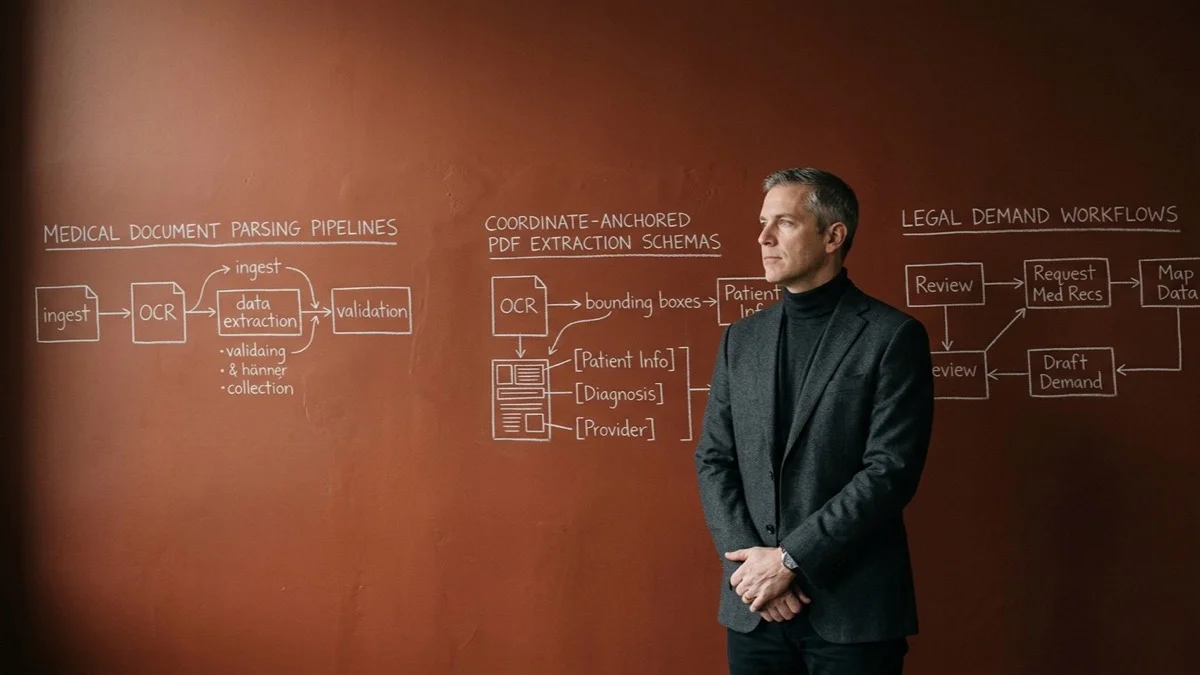
evenup alternativesWhy Litigation Practices Outgrow Rented Demand Generators, and How to Build Sovereign Document Intelligence
EvenUp proved that AI can summarize medical records and draft demand letters, but $350-plus fees per file and 72-hour turnaround create bottlenecks. An honest review of seven options.
EvenUp demonstrated to the legal profession that machine learning could digest complex medical chronologies and draft credible demand letters. When the company raised its Series D reaching a $1 billion valuation in October 2024, it validated demand preparation as an automated legal category.
Yet high-volume plaintiff and mass tort firms encounter friction with the outsourced demand model. As caseloads grow, paying hundreds of dollars for each individual case file creates margin drag, while waiting multiple days for a third-party review queue delays settlement posture.
Grounded in modern legal intake architecture, this analysis examines the real alternatives to EvenUp. It compares pricing economics, document extraction methods, evidentiary provenance, and when a firm should keep using EvenUp.
The Three Bottlenecks That Drive Firms Off EvenUp
Practices that transition away from EvenUp typically point to three operational limits:
- Per-file toll fees: EvenUp charges on a transactional or recurring quota basis, typically ranging from $350 to $750 or more for each demand letter, depending on case tier and volume commitment. A firm resolving 40 personal injury files each month can spend between $14,000 and $30,000 every month on demand generation alone. Over two years, that expenditure exceeds $330,000 for rented document drafts.
- Turnaround queue delays: Because EvenUp uses human reviewers to check LLM outputs before delivery, turnaround times typically take between two and five business days. For fast-moving intake teams that need to evaluate claim viability before signing retainers or filing statutory notices, waiting 72 hours for an initial medical summary stalls client acquisition.
- Detached output and tenant boundaries: EvenUp delivers a polished text document, but the underlying evidentiary data is disconnected from your firm core case management system. Sensitive medical records move into an external multi-tenant cloud governed by HIPAA Security Rule standards rather than your own private perimeter.
Stop Paying Hundreds of Dollars Per AI Demand Letter
Per-document demand pricing eats into firm margins on every case. OBE processes medical chronologies and extraction in-house on your private infrastructure for pennies.
Visualizing Document Extraction: Outsourced vs Sovereign
The structural difference between a rented demand generator and a private extraction pipeline centers on where data lives and how evidence is verified:
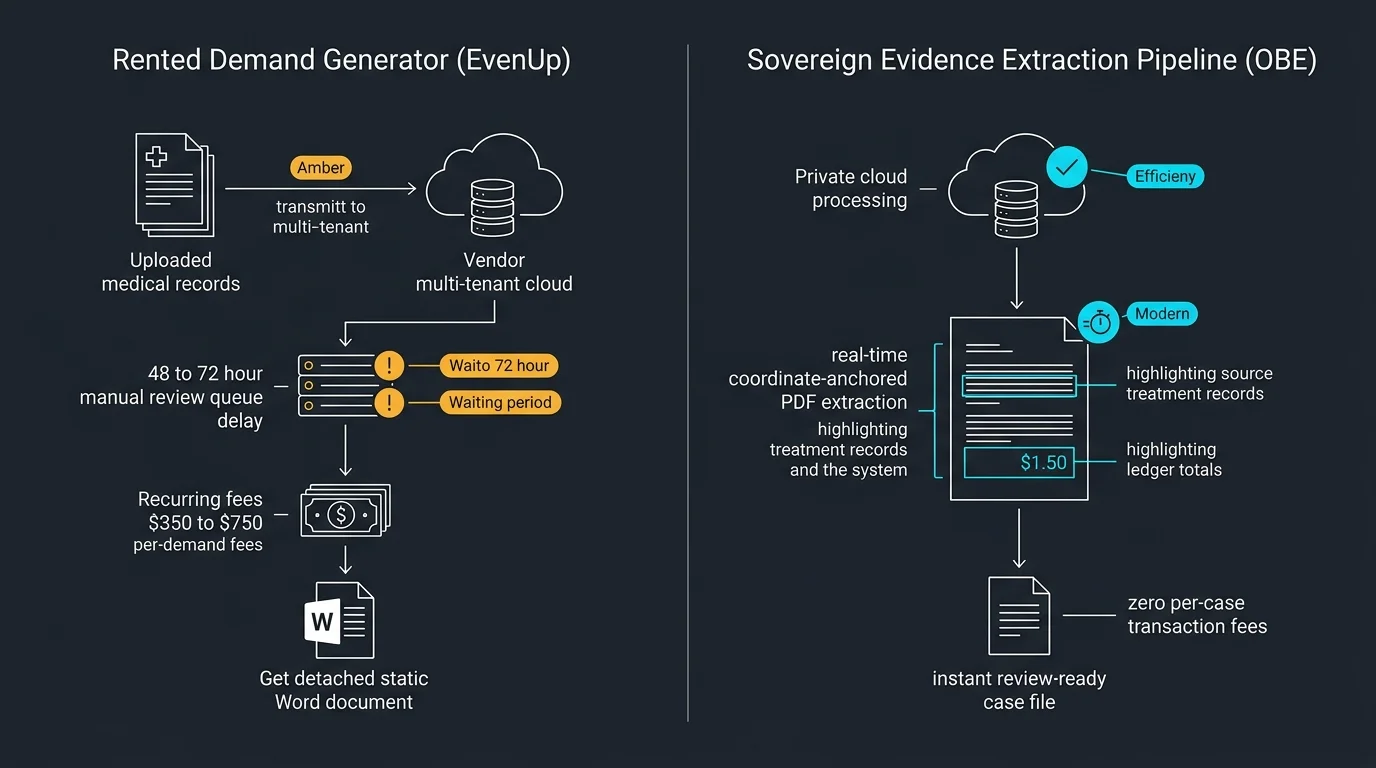
On the left, the rented vendor model treats documents as external payloads. Records travel to an outside server, wait in an offshore review queue, incur per-case fees, and return as a detached text file.
On the right, an owned intake pipeline parses records directly within the firm private cloud environment. Coordinate-anchored extraction anchors medical treatment dates, billing amounts, and provider names directly to the exact pixel coordinates on the source PDF. Attending attorneys receive a review-ready case file showing facts, evidence, conflicts, and missing information with zero per-file toll charges.
What to Evaluate in an EvenUp Alternative
Score potential replacements against five core criteria:
- Transaction economics: Do you pay a recurring toll on every case, or do you own the code and run unlimited extractions?
- Coordinate anchoring: Does the tool highlight the exact page and paragraph behind every extracted figure, or does it deliver unverified text summaries?
- Intake integration: Does extraction happen at the front door during intake qualification, or is it an isolated back-office task?
- Supervisory compliance: Does the workflow allow lawyers to satisfy supervisory requirements under ABA Model Rule 5.3?
- Private cloud isolation: Does the architecture align with recognized security standards such as NIST CSF 2.0 without sharing multi-tenant storage?
The Seven EvenUp Alternatives
1. OBE Owned Intake and Extraction Pipeline
Best for: High-volume plaintiff and mass tort firms that want to own their extraction logic and eliminate per-case software fees.
OBE replaces outsourced demand services with a production-grade intake pipeline deployed directly into your firm private cloud under a single legal practice license at $29,000 one time, with zero per-case or per-seat fees.
Rather than waiting days for an external draft, OBE parses claimant questionnaires, medical disclosures, and fee agreements during the initial intake workflow. Coordinate-anchored extraction links clinical findings and billing totals directly to the underlying source PDF. Reviewing lawyers start with a review-ready case file showing facts, evidence, conflicts, and missing information.
Honest limitations: OBE provides the underlying qualification logic, evidentiary extraction engine, and structured matter packages. It does not provide outsourced human paralegals to write prose settlement letters for you. Your firm team or internal case managers use the review-ready case package to finalize legal demands.
Skip it if: You handle three auto cases a year and want someone else to type the demand letter. Paying EvenUp per file is more economical at very low volumes.
2. Settify / Casepeer Demand Automation
Best for: Small personal injury firms standardized on the AffiniPay software ecosystem.
Practices utilizing CASEpeer or MyCase have access to native demand letter generation tools. These templates pull stored case fields, policy limits, and ledger entries directly into standard letter templates.
Honest limitations: Native case management templates do not perform intelligent document parsing. Staff must manually read medical bills and enter line items before the template can generate text.
3. Filevine DemandsAI
Best for: Litigators already committed to Filevine as their single case management environment.
Filevine introduced native AI modules, including DemandsAI, designed to analyze medical chronologies within Filevine project folders. Pricing models frequently combine core subscription rates with modular per-case or per-user add-ons, according to Costbench software reporting.
Honest limitations: Costs compound across seat tiers, Lead Docket add-ons, and AI document credits. Custom extraction logic remains bounded by Filevine release cycles.
4. Fastcase / vLex Vincent AI
Best for: Complex litigation practices that require deep statutory analysis and caselaw verification alongside brief drafting.
Vincent AI from vLex combines case document evaluation with a massive legal research database. It analyzes pleadings, identifies unmentioned judicial authorities, and drafts research memos.
Honest limitations: Vincent AI focuses on appellate argument and substantive caselaw research rather than personal injury medical indexing and billing breakdowns.
5. CoCounsel (Casetext / Thomson Reuters)
Best for: Mid-size to enterprise litigation departments that need general legal document review.
Built on GPT-4 and acquired by Thomson Reuters, CoCounsel assists litigation teams with deposition preparation, document search, and contract review. It summarizes long PDF depositions quickly.
Honest limitations: CoCounsel is an open-ended conversational legal assistant rather than a dedicated medical billing and demand calculation pipeline. It does not offer structured intake qualification out of the box.
6. In-House Medical Chronology Specialists
Best for: Regional personal injury firms that prefer direct human supervision of medical summaries.
Many firms employ internal legal nurse consultants or specialized intake paralegals who read records and assemble demand exhibits manually in Word and Excel.
Honest limitations: Human staff require competitive compensation and vacation coverage, and manual summarization takes between 8 and 20 hours of labor per complex case file.
7. Per-Case Outsourced Record Retrieval Services
Best for: Practices seeking to offload the friction of requesting medical records from hospital systems.
Vendors like ChartRequest or RecordConnect focus on retrieving medical files and organizing records into chronological binders for attorney review.
Honest limitations: Record retrieval companies deliver raw PDFs. They do not extract discrete statutory data points or integrate directly into your firm intake decision rules.
Inspect Our Multi-Model Document Extraction Workstation
Our 50/50 review interface displays extracted injuries and bill amounts alongside source medical records with exact coordinate bounding boxes.
Comparison Table: Feature Matrix and Reported Pricing
| Platform | Reported Pricing Model | Document Extraction | Turnaround Time | Data Perimeter | Best Fit |
|---|---|---|---|---|---|
| OBE Owned Codebase | $29,000 one time, $0 per case | Coordinate-anchored to PDF | Real-time at intake | 100% private cloud | High-volume plaintiff and mass tort |
| EvenUp (Incumbent) | ~$350 to $750+ per file | AI plus human check | 2 to 5 business days | Multi-tenant SaaS | Low-to-mid volume PI firms |
| Filevine DemandsAI | Subscription plus AI fees | OCR within Filevine | Hours to 2 days | Multi-tenant cloud | Existing Filevine operations |
| CASEpeer Native | ~$79 to $109/user/mo | Manual entry merge | Immediate (manual) | Multi-tenant cloud | Standard pre-litigation auto |
| vLex Vincent AI | Enterprise license | Research argument check | Minutes | Hosted cloud | Complex civil and appellate |
| CoCounsel | Per-seat subscription | General LLM summarization | Minutes | Multi-tenant enterprise | Corporate litigation teams |
| Internal Nurse Staff | $70,000+ salary per nurse | Detailed manual review | 1 to 2 weeks | Local network | High-value catastrophic injury |
Pricing data reflects publicly available buyer reports and estimated industry ranges. Legal AI pricing is negotiated and varies by firm volume commitments.
Real World Proof: Bennett Legal Scaling 0 to 642 Intakes
The economic difference between renting document extraction and owning your pipeline shows up clearly in high-volume litigation campaigns.
When Bennett Legal in Dallas launched its mass consumer litigation practice addressing solar financing fraud, every incoming claimant file required dense document qualification. Claimants uploaded 40-page loan agreements, electric bills, and cancellation letters. Staff had to verify annual percentage rates, disclosure timing, and signature authenticity on day one.
Renting external extraction and case management services created prohibitive overhead: Bennett Legal faced an audited annual tool expenditure of $44,000 for Filevine, $21,000 for Moxo, and $22,000 for data-extraction pipelines, totaling $87,000 per year, with staff and lawyer time excluded.
Bennett Legal replaced that patchwork with OBE sovereign intake pipeline deployed to private cloud infrastructure. The firm scaled from zero to 642 review-ready intakes, with statutory violations anchored directly to coordinates on the underlying financial contracts.
The architecture and financial breakdown of this deployment are detailed in the Bennett Legal case study and explained on /stop-renting.
Recommendation by Firm Situation
- "We resolve more than 20 personal injury files each month." At that volume, per-case demand generation fees create significant margin loss. Moving extraction in-house via an owned codebase eliminates per-file charges permanently.
- "We resolve fewer than five personal injury claims a month." Keep using EvenUp or a reputable per-file vendor. Paying per file is cheaper than running internal software infrastructure at small scale.
- "Our primary bottleneck is medical record retrieval, not demand writing." Hire an outsourced retrieval service to gather records first, before investing in specialized AI tools.
- "We handle complex claims with strict statutory requirements." Rented text generators cannot verify case-type statutes accurately. You need coordinate-anchored extraction that proves exactly where each violation appears in the claimant documents.
Frequently Asked Questions
What is the primary difference between EvenUp and OBE?
EvenUp is an outsourced service that generates demand letters for personal injury practices on a per-case fee model. OBE is an owned intake pipeline deployed to your private cloud under a one-time license that screens claimants and extracts evidentiary facts directly from source PDFs at zero per-case cost.
How much does EvenUp cost per case?
EvenUp does not publish public rate cards. Industry procurement estimates indicate pricing from $350 to over $750 per demand letter depending on case severity and monthly commitment tiers.
Does OBE generate settlement demand prose?
OBE extracts verified facts, treatment timelines, and billing totals, and organizes them into a review-ready case file showing facts, evidence, conflicts, and missing information. Your firm team uses this structured package to generate demands or file arbitration claims.
How long does it take to deploy an owned extraction pipeline?
OBE deploys to your firm private cloud infrastructure in approximately two weeks. Your team starts with structured case data and a review-ready legal issue map tailored to your specific litigation workflows.
Ready to eliminate per-file fees and own your document extraction pipeline?
 Schedule a Consultation with Tim Ottowitz
We will review your current case volume, analyze your medical record extraction workflows, and show you what sovereign document intelligence looks like in production.
Schedule a Consultation with Tim Ottowitz
We will review your current case volume, analyze your medical record extraction workflows, and show you what sovereign document intelligence looks like in production.
Find the Right Intake Software and Developers for Your Firm
Ready to build your own document extraction pipeline instead of paying per document?
👉 Schedule a Consultation with Tim Ottowitz to Review Your Case Type
We will inspect your medical records workflow, benchmark extraction error rates, and show you how OBE delivers review-ready demands at flat cost.
Let us build your intake
Want us to build this exact intake pipeline for your firm?
Send us your intake questionnaire, retainer agreement, and document checklist. We will build, test, and deploy a custom, review-ready intake flow for your practice area.
Build My Intake Pipeline